
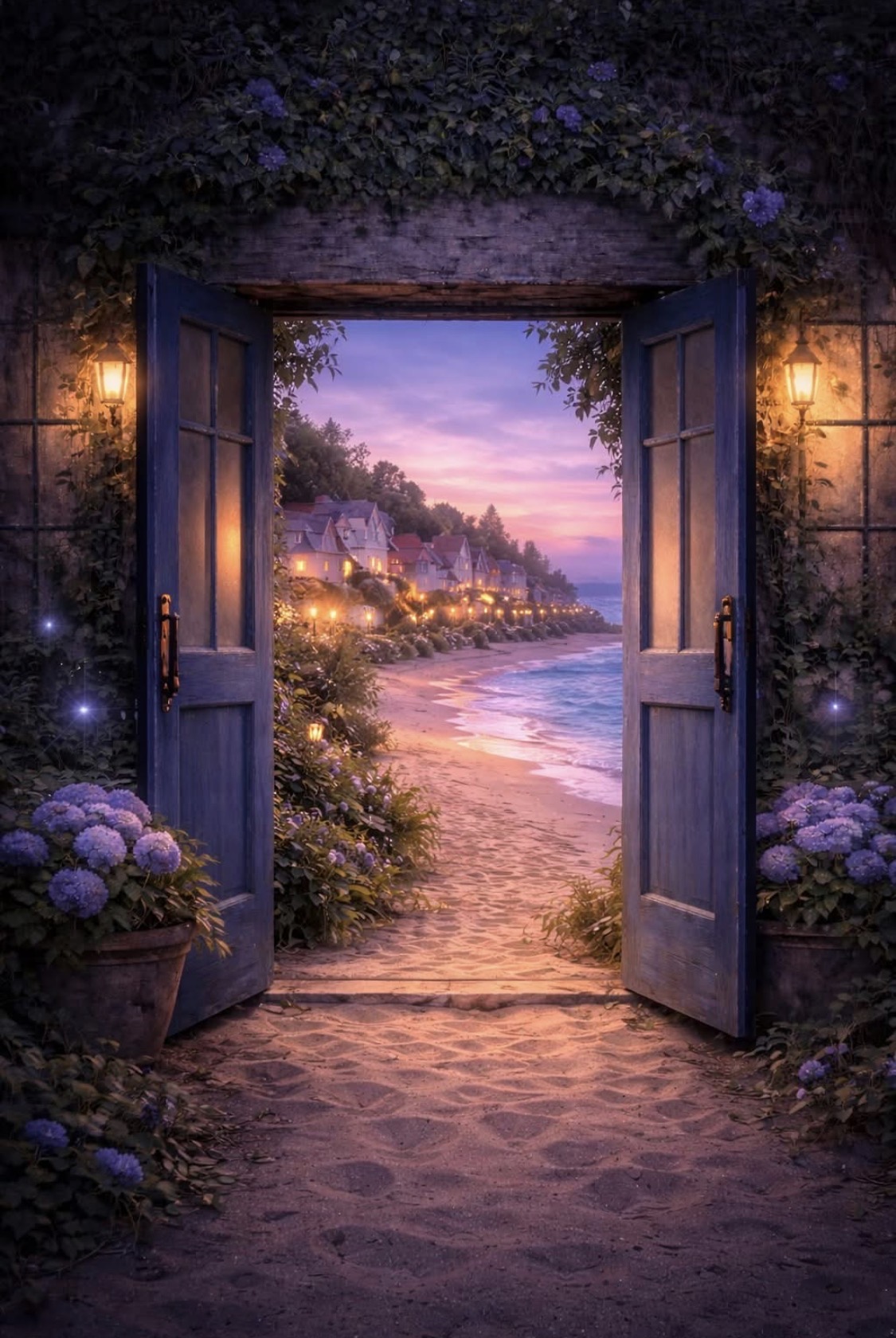
Most thresholds are unimpressive.
No bells.
No gates.
No lightning splitting the sky.
A stair creaks twice instead of once.
A window reflects a room with different furniture.
A shadow remains on the pavement one breath longer than the person who cast it.
You look again.
Everything is normal.
Of course it is.
The hidden world has manners.
It does not insist.
It waits.
Entering one is rarely dramatic.
It is intimate.
You stand in a hallway.
The light is ordinary.
The air is ordinary.
Nothing announces itself.
And yet your skin remembers something your mind does not.
Your fingertips tingle as though brushing against an unseen curtain.
Your breath slows.
Your hearing sharpens around the edges.
The room seems both closer and farther away.
You are located and unlocated at once.
Present, but not entirely contained by the present.
It is like standing in the pause before the tide returns.
There are writers who have tried to describe this.
Proust found a door in a madeleine dipped into tea and watched time unfold from it.
Poe understood that silence could acquire texture.
Lovecraft suspected that the world became most frightening when it stopped explaining itself.
But I think they were all pointing toward the same seam.
The place where reality becomes briefly less certain of its own borders.
You may feel it as dread.
You may feel it as beauty.
You may feel nothing more dramatic than the sudden conviction that something has changed, although nothing has moved.
And if someone were standing beside you and asked what was wrong, you might not know how to answer.
You might look toward the window.
Toward the sea.
Toward the dark line where the visible world seems to end.
And you might say:
Something is watching the horizon from beneath.
Not threatening.
Not waiting to emerge.
Simply aware.
As if the world has blinked and for one blink you have fallen between its eyelids.
Most people recover quickly.
They look at their phones.
They turn on a light.
They name the thing.
Memory.
Coincidence.
Imagination.
Fatigue.
A trick of the weather.
And the aperture narrows again.
The hallway becomes a hallway.
The shadow behaves.
The room returns to its proper dimensions.
This is not failure.
A person cannot live forever with every door open.
But sometimes the aperture remains.
Just a little.
And afterward, you begin noticing things.
The scent of rain when there are no clouds.
A flicker of blue that the sky did not make.
A sentence heard in a dream that follows you into breakfast.
A song that seems to remember you.
A photograph in which someone appears to be looking not at the camera but through it.
You begin to suspect that moments are not as small as they look.
That some contain entire rooms.
Some contain roads.
Some contain versions of you who turned left where you turned right.
Some contain people exactly as they were before you lost them.
Some contain futures that never happened and nevertheless leave footprints.
And once you have noticed this, it becomes difficult to believe entirely in the myth of a single world.
Not because this world disappears.
It does not.
The cup remains on the table.
The train still arrives or fails to arrive.
The body still grows tired.
Rain still falls downward.
Mostly.
But the edges become less obedient.
You begin to understand that a moment can hold several meanings without collapsing beneath their weight.
That a person can love and leave.
Remember and forget.
Know and doubt.
Belong and remain elsewhere.
That one truth does not always need to murder another in order to survive.
Perhaps this is why the aperture frightens people.
A single world asks very little of us.
It says:
Choose.
Name.
Decide.
Continue.
But the Many-World Aperture asks something harder.
It asks whether you can remain present while more than one possibility breathes beside you.
Whether you can stand at the threshold without immediately closing the door.
Whether you can allow the world to remain unfinished for another moment.
That is where stories begin.
Not with certainty.
With the seam.
With the almost.
With the door that may or may not have been there yesterday.
With the feeling that something has changed beneath the surface of the ordinary.
And if you walk slowly enough, you may notice it.
The seam trembling.
The air shifting.
The world thinning just enough for another shape to become visible through it.
You may feel the Many-World Aperture open.
You may take one more step than you intended.
And then the shoreline changes shape beneath your feet.

Leave a comment