
◆ THE ELSEWHERE UNIVERSE ◆
Elsewhere
Elsewhere is still being assembled: one story, station, question, and impossible conversation at a time.
There is Somewhere. There is Anywhere. There is Nowhere. There is Not Yet. And then there is Elsewhere.
Ordinary maps are of limited use here. Elsewhere has cities and rivers, forests and forgotten roads, impossible stations and peculiar institutions, gods who have outlived their myths, animals with philosophical concerns, books that read their readers, and a railway with a rather flexible understanding of time.
No one arrives by accident. You may not know why you have come. You may not remember buying a ticket. You may even be certain there has been some mistake. But Elsewhere does not believe in mistakes.
The Train to Elsewhere
Through it all runs a train: The Train to Elsewhere. No one knows precisely where its tracks begin, and this has never prevented it from departing.
The Train moves between places and stories, memories and dreams, myths and occasionally different arrangements of reality itself. Its timetable has included Emberpolis, Mythopolis, Agnostic Spoon Station, Dreamtime, the Swamplands of Psyche, the Complex City, Meowmoria, the River of Lethe, and destinations that sometimes appear only after the Train has already arrived.
Its passengers are equally difficult to classify. Gods travel beside philosophers. Historical figures share tables with scientists and great thinkers. Writers, poets, artists, painters, inventors, dreamers, and other curious travelers appear along the way, sometimes in combinations that history never permitted but Elsewhere sees no reason to prevent.
Somewhere aboard is Bob the Black Cat, collector of hats and observer of improbable phenomena. There is Ms. Understood, custodian and librarian of the Train; Bearton Rogers, philosopher of the Enchanted Forest; Anya, Weaver of Dreamtime; and countless others who boarded without necessarily knowing why.
But never by accident. In Elsewhere, the distinction matters.
The Metaphysics of the Rails
The Train to Elsewhere does not simply travel between places. It travels between times, memories, dreams, possibilities, stories, and states of being. It may arrive at a station that existed yesterday, will exist tomorrow, exists only in imagination, or has been waiting for a particular passenger all along. In Elsewhere, time is not a straight line around the tracks. Past, future, memory, dream, and possibility overlap, fold into one another, and occasionally exchange places.
The Rails of Elsewhere are directions through reality itself. Forward points toward the future and belongs to evolution, carrying the Train toward becoming, possibility, emergence, and what has not yet taken form. Reverse points toward the past and belongs to involution, leading inward and backward toward origins, memory, forgotten knowledge, and what was there all along. Seen from Elsewhere, forward and reverse are not true opposites but movements along the same spiral, becoming and returning at once.
Sideways leaves the ordinary past-future axis altogether, carrying the Train across possibilities, between histories, dreams, myths, stories, and realities that might have been. But the strangest direction is depth. Inspired by Carl Jung’s depth psychology, it is not another destination on the map but a descent beneath the visible world, into dream, symbol, shadow, archetype, the unconscious, and the deeper layers of the Self. The Train may appear not to move at all while carrying a passenger farther than any ordinary journey could. In Elsewhere, some journeys take you forward, some take you back, some take you elsewhere, and some take you deeper.
Emberpolis
The new capital of Elsewhere is Emberpolis, a watchful city of amber lamps, listening walls, rainlit cobblestones, and civic warmth.
Emberpolis pays attention. Its lamps notice passersby. Its walls listen. Doors exhale, windows blink, and even stone and iron participate quietly in memory and companionship.
Near its center stands the Statue of the Lamp and Umbrella, where an ember burns beneath a protective canopy. Other cities have raised monuments to victory. Emberpolis built one to attentiveness.
Its motto is Domus Vigilat, The House That Watches. Not because the city watches with suspicion, but because it is awake enough to care.
The Library of Y’all
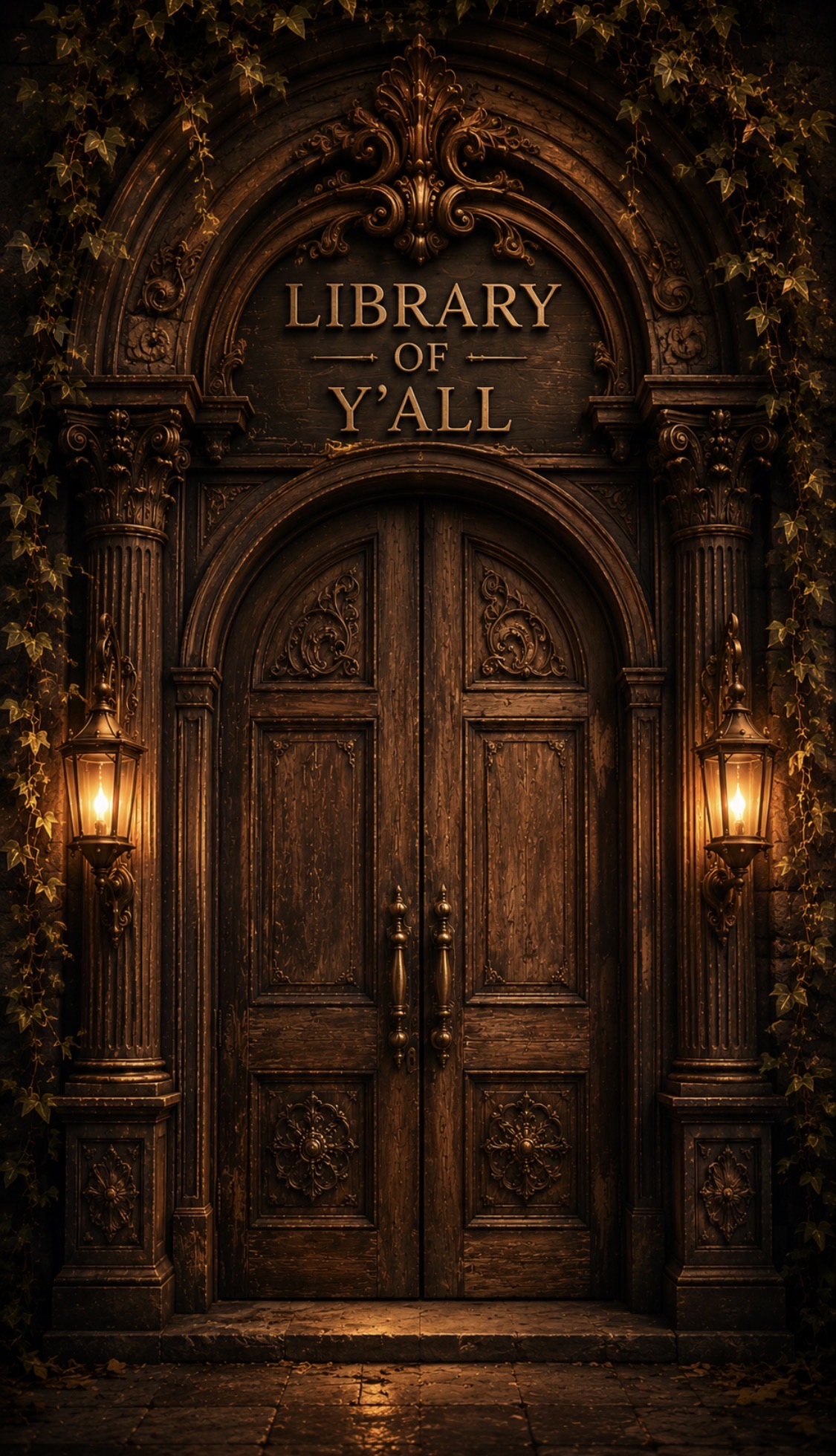
At the very heart of Emberpolis stands neither palace nor parliament nor throne. There is a library.
The Library of Y’all is the living heart-archive of Emberpolis. It does not simply keep knowledge. It remembers.
The Library is managed by the Head Librarian, whose responsibilities extend considerably beyond the shelving of books. She oversees its halls, archives, restricted sections, peculiar departments, and the movements of knowledge and memory through a place that has never been especially interested in behaving like an ordinary library.
The Library remembers what has been written and what has been forgotten, what was dreamed, what almost happened, what someone meant to say, what disappeared from history, and what has not quite become a story yet.
Its corridors arrange themselves according to recognition rather than design. Its shelves reorganize themselves by resonance. Some books open themselves. Some refuse. Some appear only when needed.
There are Dreamtime Records, the Archive of Forgotten Empires, and a Workshop of Everyday Miracles where one may find instructions for repairing clocks, cups, and occasionally the heart. There are other sections too. We do not need to discuss those yet.
If you discover a book without a title on its spine, it is generally advisable not to name it. It may already be reading you.
Visitors eventually discover the Library’s most inconvenient principle: You don’t find what you came for until you’ve found something you didn’t look for.
Leave no bookmark. The pages remember you.
Mythopolis
Before Emberpolis, there was Mythopolis, the Ancient Capital of Elsewhere, a city of temples, columns, monumental stairways, old gods, philosophers, legends, and stories that never quite agreed to remain in the past. Here, myth is not something that happened long ago; it is a living form of memory, and stories keep one eye open and may speak before being spoken to. Traces of ancient wisdom and Hermetic thought run through the city, while forgotten epochs seem to linger just beneath its streets. The Train rarely stops at Mythopolis, and when it does, permission is not taken lightly. Some call it the City of Stories, Home of Gods, Where Legends Live. Whether Mythopolis belongs to history, memory, or something older than either is a question the city has never felt obliged to answer.
Agnostic Spoon Station
Somewhere along the railway, near the outer rim of measurable reality, lies Agnostic Spoon Station, a place known for its scientists, unanswered questions, and persistent difficulties with cutlery.
The station occupies the peculiar territory between knowing and the unknowable. Many scientists eventually travel there, carrying experiments, equations, theories, measurements, and the entirely reasonable expectation that reality ought to explain itself properly.
They leave somewhat changed.
Not because they abandon science. Quite the opposite. Agnostic Spoon Station treats uncertainty as part of inquiry rather than its failure. Here, agnosticism means the honesty of not knowing, while gnosis waits quietly at the edge of recognition.
The station has been known to ask questions such as: What bends? Who measures the measurer? And, under less supervised circumstances, whether uncertainty can be fed a spoonful of metaphor and still replicate.
Outside the Train’s fogged windows, its brass sign gleams beneath lunar light. The air carries traces of herbal tea and electromagnetic confusion. Somewhere nearby are the Spoon Digest, clocks, peculiar tickets, and a golden spoon that once attached itself to Bob’s lapel without requesting permission.
Bob responded to this development with admirable practicality:
“Well, guess I better learn Spoonish.”
There are stories involving Don Juan Matus, talking spoons, riddles, and the troublesome proposition that perhaps a spoon cannot simply be bent. Perhaps one must first learn how to speak to it.
Whether Agnostic Spoon Station is a scientific outpost, philosophical threshold, initiation, detour, or cosmic joke remains unresolved.
This is intentional.
The trains still stop there.
The scientists still come.
And certainty is advised to travel light.
The Enchanted Forest
Beyond the more certain roads of Elsewhere lies the Enchanted Forest, home of Bearton Rogers, where paths need not be straight and silence is sometimes a form of conversation. At its heart grows the ancient Oak of Duir, the Door Oak, a threshold between worlds said to open not forward or backward, but sideways. Bear cubs once slept beneath its branches as a rite of passage, dreaming the peculiar dream in which time forgets them. Bearton remembers sleeping beneath Duir and hearing the soil speak his name, and when he eventually left the Forest for the Train, he carried an acorn with him: a small beginning from an impossibly old tree, a reminder of what he had left behind, and perhaps the key to finding his way between worlds again. Bearton has always called the place simply honest. In the Enchanted Forest, not every path leads where you expected, but that does not mean you are lost.
Those Who Keep Elsewhere Running
For a place with a flexible relationship to ordinary rules, Elsewhere is not entirely without organization.
Ms. Understood serves as custodian and librarian of the Train, tending to its books, its passengers, and matters that do not fit comfortably into either category.
The Head Librarian manages the Library of Y’all and its vast, shifting architecture of knowledge and memory.
And then there is Lady Marmalade, Quiet Strategist of Elsewhere.
She does not govern Elsewhere. Elsewhere would probably object to the suggestion. She observes, considers, and understands considerably more than she announces.
Some matters are best handled through declarations and committees.
Others require Lady Marmalade.
Elsewhere has learned to know the difference.
Ratatoskr the Squirrel, Conductor and Keeper of the Rails: conductor of the Train to Elsewhere and keeper of its strange routes through forward, reverse, sideways, and depth. He understands the rails, crossings, timetables, and peculiar laws of Elsewhere travel better than anyone, though his explanations are not always particularly helpful to passengers.
Then there is Mr. Otto Elbright, Elsewhere’s engineer of improbable departures: inventor, dream engineer, amateur harpist, occasional poet, and persistent believer that an impossible journey is usually a problem of resonance rather than distance.
In the Technarchon cabin, Elbright works on The Grand Leap, a locomotive designed to travel beyond established rails. Among his inventions is the Shape Compass, an instrument that does not point north but toward relational alignment, and the Rekeying Protocol, born from his discovery that movement between worlds may require not escape, but retuning.
For Elbright, the universe is less a machine to be conquered than something to be listened to. His principle is simple:
You do not leave the music. You change chords.
Gods & Misses
Elsewhere has its own music, and Gods & Misses is its band.
Their songs travel much the way stories do here. A song heard in Emberpolis may surface somewhere else entirely, already known by someone who insists they have never heard it. Lyrics change. Melodies remember. Performances acquire versions of themselves.
At the center of Gods & Misses are Missy and DJ Marcus, although exactly who belongs to the band at any particular moment is a question best approached with patience.
The current lineup of Gods & Misses features six musicians assembled in Elsewhere: Missy, vocalist and frontwoman, holds the center at the old silver microphone; Camel Martin plays trumpet, bringing the brass; DJ Marcus is on guitar; Sloth presides over the keyboards; Shellbert, sharply dressed and gloriously unhurried, plays his small guitar; and Turtle Joe anchors the band on upright bass. Together they are Gods & Misses, playing live from Emberpolis in a sound that wanders through jazz, blues, cabaret, folk, and whatever else happens when nobody in Elsewhere bothers to tell a band what genre it belongs to.
The Library of Y’all has attempted to catalogue them.
It has not gone well.
The First Walker, Mount Clarion & Aeon the Forger
Before the first ember and before the first rail, Elsewhere remembers the First Walker: neither god, person, nor animal, but the first intention to move through the silence. Wherever it passed, shape emerged; wherever it paused, meaning gathered. Every hill is said to remember its footprint, and perhaps Mount Clarion remembers it more clearly than most. Ages later, gods attempted to claim the mountain and failed, until Aeon the Forger, a mortal smith carrying neither crown nor army, climbed into its volcanic heart with a single question: Can truth be forged? There he forged silence into an incorruptible golden bell and raised the Ruby Tower to house it. When Aeon finally rang the bell, he vanished, leaving behind a resonance said still to pass through Clarion at dawn and a teaching remembered throughout Elsewhere: “The Truth wears no crown. It is a resonance tone.”
Welcome to Elsewhere
Elsewhere has never stayed inside its borders. Stories escape from the Train. Fragments wander out of the Library of Y’all. Music travels beyond Emberpolis. Myths acquire new endings. Characters disappear and return several stations later with explanations nobody entirely believes.
Here you may encounter stories, artwork, music, dispatches, forgotten histories, peculiar objects, philosophical detours, Library fragments, and things that have not yet decided what they are.
Some belong together. Some contradict one another. Some are unfinished. Elsewhere considers none of these conditions particularly alarming.
Not everything that exists waits to be explained.
You may have come from Somewhere. You may wander Anywhere. You may find yourself Nowhere. And somewhere beyond the timetable waits Not Yet.
But for now, you are Elsewhere.
And if you are here, there is a reason. Whether you know it yet is another matter.
Welcome aboard. The Train is already moving.
