
After waking from a strange encounter with a Triangle, Missy decided to take a walk through the Big City of Nowhere.
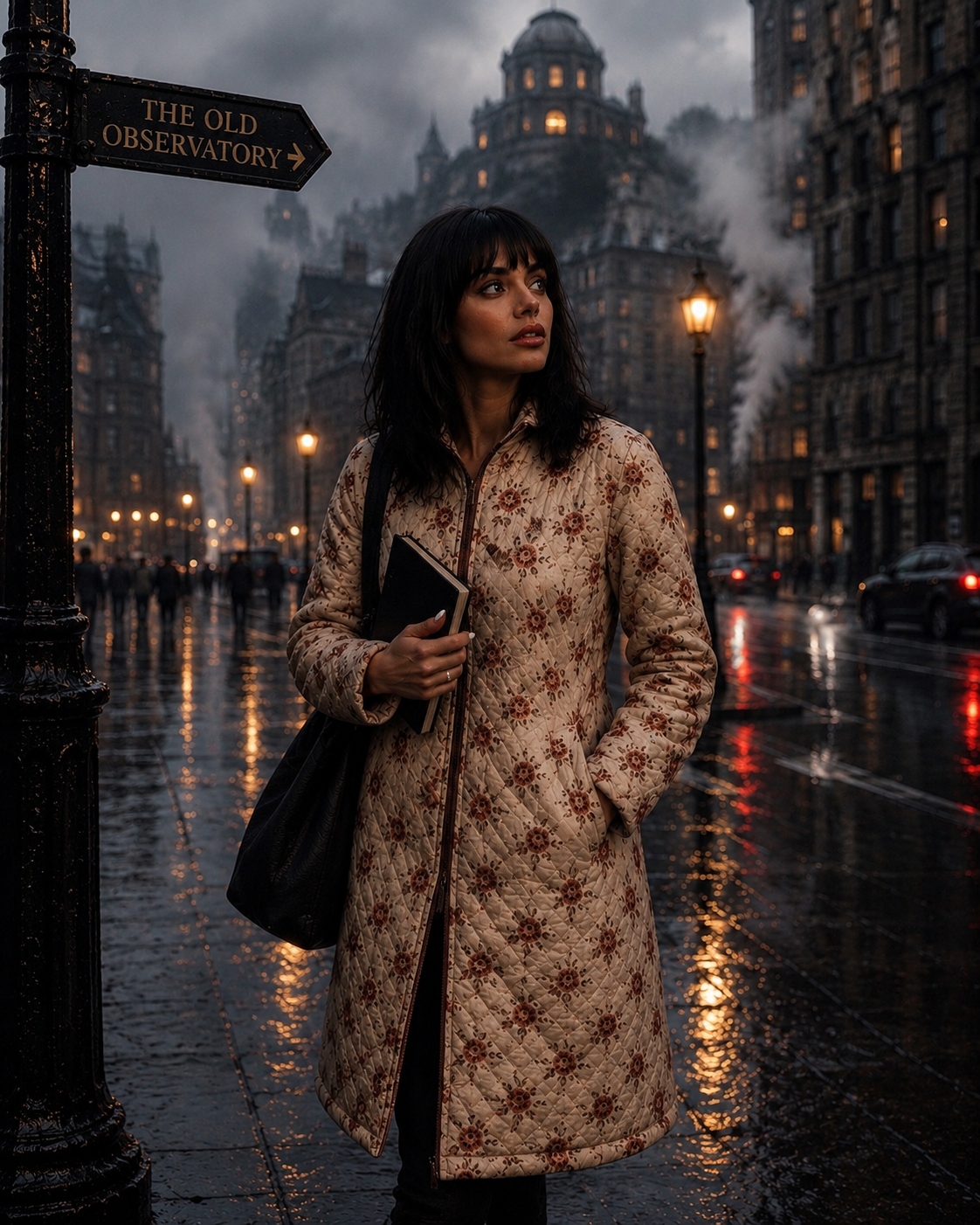
She also intended to conduct some research.
The Triangle had left her with several questions, three possible coordinates, and the uncomfortable suspicion that reality had more sides than it was willing to admit.
Missy’s way of conducting research was rather unconventional.
She would walk out of the door, choose a destination, and then completely disregard it whenever a hunch suggested somewhere more interesting.
This method had very little respect for maps.
It had, however, produced excellent results.
Missy believed that facts behaved differently when they did not know they were being observed. If approached too directly, they became formal and unhelpful. But if one wandered past them while thinking about something else, they occasionally revealed everything.
So she packed her notebook, two pencils, a small magnifying glass she had never once used for magnification, and a piece of toast for emergencies.
Then she stepped into the city.
The Big City of Nowhere was having a gloomy, rainy day.
Rain gathered in the gutters and slipped down the darkened windows. The buildings stood silently beneath a low grey sky, their upper floors disappearing into mist.
Shopkeepers watched the empty pavements from behind their glass doors but seemed in no hurry to open them.
Somewhere beneath the street, a train announced its arrival at a station that did not appear on any public map.
Missy chose the Old Observatory as her destination.
Three streets later, she noticed a blue ribbon tied around a lamppost.
As she passed, the knot loosened.
The ribbon slipped free, lifted into the rainy breeze, and fluttered down the street as though it had suddenly remembered an appointment.
Missy watched it turn into a narrow passage.
She looked toward the Old Observatory.
Then toward the ribbon.
“Research,” she said, and followed it.
The ribbon carried her past a shop selling clocks that measured hesitation and into a quiet neighborhood where every building appeared slightly familiar.
She stopped.
Across the street stood a small café.
Missy was certain she had never visited it.
She was equally certain that she remembered leaving it.
In one of its windows, she saw her own reflection walking in the opposite direction.
Missy opened her notebook.
“Promising,” she murmured.
The blue ribbon fell gently at her feet.
When Missy entered the café, she found the Storyteller seated alone beside the window. An open book rested on the table before her, although its pages appeared blank.
“You followed the ribbon,” the Storyteller said.
“It seemed methodologically significant.”
“Is that what we are calling hunches now?”
“Only when they produce results.”
Missy placed the ribbon on the table and sat opposite her.
“I saw my reflection walking in the wrong direction.”
“Perhaps it was walking in the right direction in the wrong world.”
Missy reached for her pencil.
The Storyteller looked through the rain-streaked window toward the darkened city.
“Write this down,” she said.
And then the Storyteller began.
There is a moment, subtle and easily missed, when the mind discovers that reality is not a single line but a corridor of possibilities.
Most people walk that corridor without noticing the doors.
They believe there is one world, one self, one path, one story.
But sometimes the corridor changes.
A door appears where there was no door before.
A familiar room seems to contain more space than it did yesterday.
A memory returns wearing different clothes.
A choice you did not make suddenly stands beside the choice you did, quietly alive.
This is the Many-World Aperture.
It is not another world replacing this one.
It is the opening through which more than one truth can remain visible at once.
We are taught early to close that opening.
Choose one answer.
Choose one interpretation.
Choose what happened.
Choose who you are.
Choose what something means.
And once you have chosen, close the other doors.
This is useful.
It keeps dinner conversations manageable.
It allows maps to remain maps.
It helps people agree on where the staircase begins and whether the train has already left.
But reality has never been particularly interested in remaining manageable.
Continue the journey
Enjoying The Train to Elsewhere?

Leave a comment