
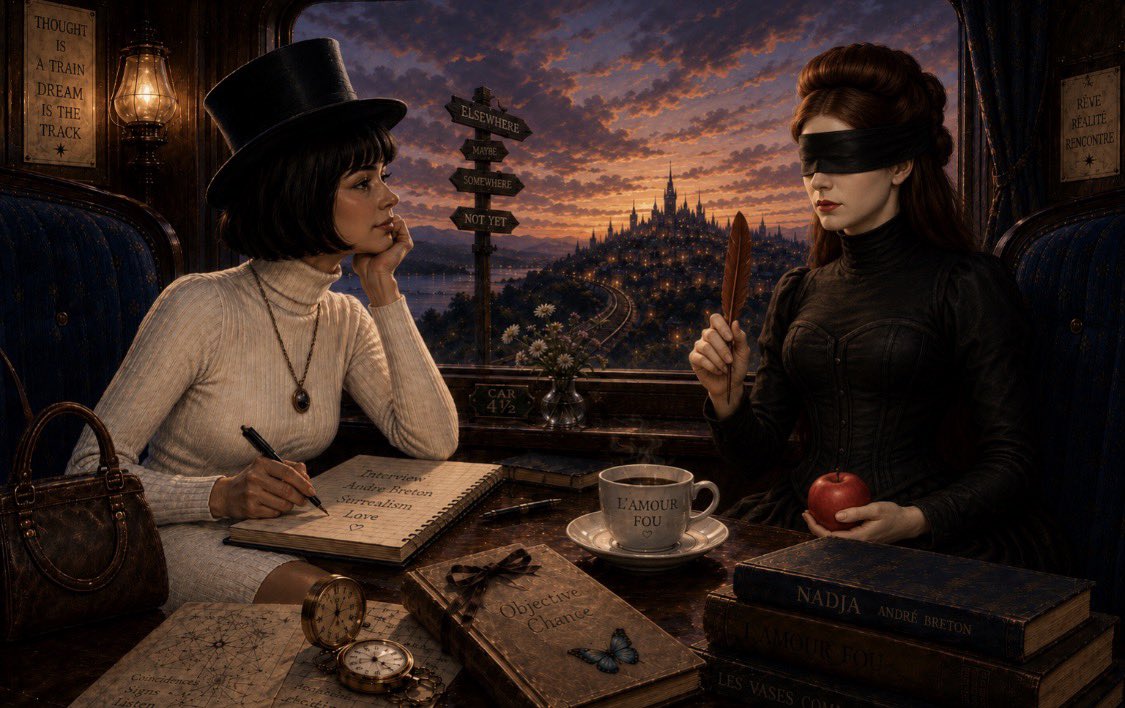
It was not very often that the Storyteller appeared on the Train to Elsewhere.
In fact, Missy had begun to suspect that she observed a timetable known only to herself and perhaps a few particularly old stars.
Whenever the Storyteller appeared, however, something unusual was usually underway.
A crossing.
A convergence.
A forgotten station returning to the timetable.
Or, most often, a change of direction.
The train was one of the few things in existence capable of traveling forward and backward through time, and reversing the rails was considered a delicate affair.
Stories sometimes shifted places.
Memories occasionally traded hats.
Entire conversations were known to arrive before they happened.
Tonight appeared to be one of those nights.
Outside the window, the sky shimmered with colors that could not quite decide whether they belonged to dusk or dawn.
The stars hung unusually low, as though listening.
Missy sat alone in Car 4½ with a notebook open before her.
Across the top of the page she had written:
Interview with André Breton
Below that she had scribbled several questions and crossed out most of them.
What is objective chance?
Can love alter reality?
How does one distinguish destiny from coincidence?
She tapped her pen thoughtfully.
The truth was that she had been thinking less about Breton and more about origin stories.
The longer she studied them, the stranger they became.
Egypt.
Greece.
The Northlands.
Dreamtime.
Religions.
Poems.
Philosophers.
Scientists.
Each seemed to tell a different story.
And yet beneath the differences she sensed familiar patterns.
Order emerging from chaos.
Light emerging from darkness.
Meaning emerging from mystery.
As though humanity had spent thousands of years describing the same mountain from different sides.
She was so absorbed in thought that she nearly jumped when a familiar voice spoke from the opposite seat.
“What is on your mind, Missy?”
She looked up.
The Storyteller sat there comfortably, as though she had occupied the seat all evening.
Missy blinked.
“When did you get here?”
The Storyteller glanced toward the window.
“Oh, several paragraphs ago.”
“That is not a real unit of time.”
“It is on this train.”
Missy smiled.
“I was thinking about origin stories.”
“Ah.”
“They all seem remarkably similar.”
The Storyteller folded her hands.
“Most truths enjoy wearing different costumes.”
Outside, the train began the slow process of reversing the rails.
The city lights beyond the window shimmered like scattered fireflies.
For a moment it seemed the entire world was holding its breath.
Missy noticed something then.
The Storyteller was not looking at the landscape.
She was looking at Missy.
The way a librarian looks at someone standing in exactly the right aisle.
The way a gardener looks at a seed.
The way a story looks at a reader just before opening its first page.
Missy leaned forward.
“So who created the world?”
The Storyteller smiled.
“Which one?”
Missy sighed.
“The big one.”
“That narrows it down considerably.”
“The world.”
“The entire world.”
“The whole thing.”
The Storyteller considered this.
“There are many origin stories, Missy.”
“I know.”
“But tell me your favorite.”
The Storyteller rested her hand upon an ancient book that had just appeared out of nowhere.
“My favorite changes from century to century.”
“That’s cheating.”
“It is adaptation.”
Missy laughed.
The Storyteller laughed too.
Then her expression softened.
“But these days…”
She looked down at the cover.
The Story of Ptah.
“…these days I find myself returning to this one.”
The book was small and black and worn smooth by centuries of handling.
Gold letters glimmered softly in the lantern light.
Its pages rustled.
Like distant wings.
“Long ago,” the Storyteller said, “in Egypt, there was a god named Ptah.”
Missy reached for her notebook.
The Storyteller raised one finger.
“No notes yet.”
Missy reluctantly lowered the pen.
“Why?”
“Because beginnings dislike being interrupted.”
The Storyteller opened the book.
The lanterns in Car 4½ dimmed.
Outside, the last fragments of city disappeared.
There was only darkness now.
Not ordinary darkness.
Older darkness.
The kind that seemed not to conceal things, but to precede them.
The Storyteller began.
“Before temples, before kings, before anyone had invented the word before, there was Ptah.”
Missy listened.
“He did not begin with clay.”
“No?”
“No.”
“Water?”
“No.”
“An egg?”
“Not in this story.”
Missy settled deeper into her seat.
“What did he begin with?”
The Storyteller touched two fingers lightly to her chest.
“With the heart.”
Then she touched her lips.
“And with the tongue.”
Missy frowned.
“That sounds inconvenient.”
“For eating, perhaps.”
The Storyteller turned a page.
“For creating, it was quite sufficient.”
According to the old theology of Memphis, she explained, Ptah conceived things first within the heart.
The heart was not merely the place of feeling.
It was the place of understanding.
Intention.
Thought.
The inward chamber where something could exist before it existed anywhere else.
“And then?” Missy asked.
“Then he spoke.”
The train gave a quiet shudder.
Somewhere beneath them, metal groaned as the rails completed their reversal.
“What did he say?”
“Names.”
The Storyteller looked toward the dark window.
“And when things were named, they entered the world.”
Missy was silent.
The Storyteller continued.
“The gods. The towns. The temples. The crafts. The fields. The order of things.”
“Just by saying them?”
“Not quite.”
Missy waited.
“The word came after the imagining.”
The Storyteller placed one hand over her heart again.
“First, the thing had to exist here.”
Then she touched her mouth.
“Only then could it cross the threshold.”
Missy looked down at her notebook.
The blank page suddenly seemed less blank than before.
“So Ptah thought the world and then spoke it?”
“In the simplest telling, yes.”
“That sounds suspiciously like writing.”
The Storyteller smiled.
“I wondered when you would notice.”
Book of Moments Reading Path
Read Before: Chapter Five: Nothing, Something, Everything
Read After: Chapter Seven: The Beginning Before the Beginning

Leave a comment