
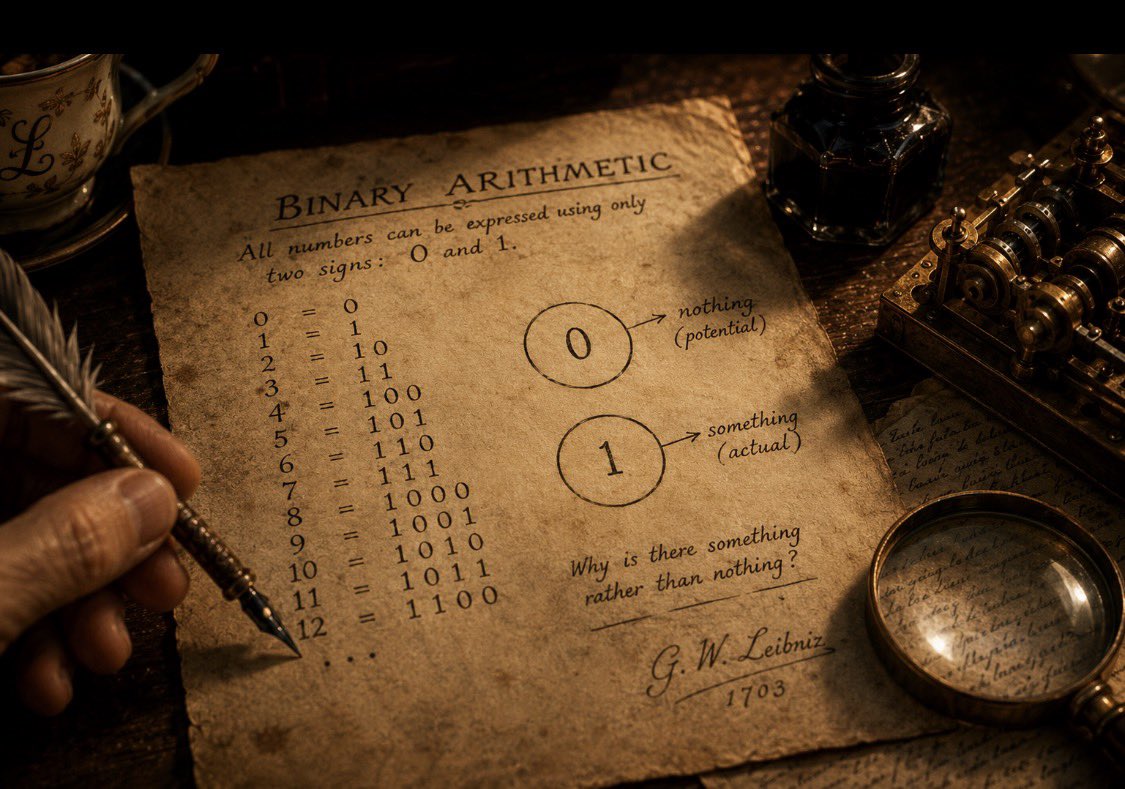
The next morning, or possibly the same morning placed differently, Leibniz turned the paper over.
Missy watched.
She had learned that philosophers did this when the first side of the paper had become insufficient.
He dipped his pen into the ink and wrote:
0
Then beside it:
1
Missy waited.
Leibniz put down the pen.
“That’s it?”
“That is enough.”
She looked at the page.
Then at the enormous piles of books surrounding him.
“You’ve written considerably more than that.”
“Unfortunately.”
Missy nodded.
She understood.
Leibniz had become fascinated by a very simple possibility.
What if numbers did not require ten different digits?
What if everything could be expressed using only two?
Zero.
One.
Nothing else.
He wrote beneath them:
0 = 0
1 = 1
2 = 10
3 = 11
4 = 100
5 = 101
6 = 110
7 = 111
8 = 1000
Missy leaned closer.
“Your numbers are getting longer.”
“They are binary.”
“That does not make them shorter.”
“No.”
“Just checking.”
Leibniz continued writing.
Missy watched the ones and zeroes multiply across the page.
It seemed impossible that so little could become so much.
Two symbols.
Again and again.
Different arrangements.
Different numbers.
An entire arithmetic emerging from the distinction between one thing and another.
Or, perhaps more strangely:
between something and nothing.
Centuries before computers learned to count this way, Leibniz had already found magic in two symbols.
But mathematics was never merely mathematics for very long when Leibniz was nearby.
He saw metaphysical significance in the two symbols.
1
Unity.
Being.
God.
And:
0
Nothing.
Non-being.
The absence from which creation appeared.
Missy looked at the zero.
“So that’s nothing?”
“Symbolically.”
She put her finger inside the circle.
“There seems to be quite a lot of room in it.”
“It is a numeral.”
“I know.”
She continued looking at it.
Zero was peculiar.
It represented nothing.
But it had to exist in order to represent nothing.
Missy smiled.
“Your nothing is something.”
Leibniz looked at her.
“It is a symbol for nothing.”
“Which is something.”
“A symbol.”
“Something.”
“Yes, but…”
Missy waited.
Leibniz stopped.
She smiled.
It was not often one could inconvenience a philosopher using only one word.
She moved to the 1.
“And this is something.”
“In the symbolism, yes.”
“So you have nothing and something.”
“Yes.”
“And from those you get everything?”
“Every number can be represented using them.”
Missy looked around.
The books.
The clock.
The calculating machine.
The train beyond the window.
The black cat on the windowsill.
Herself.
Leibniz.
His hat, currently still on her head.
“Everything?”
“Numerically, everything that can be represented in the system.”
“That was a much less exciting answer.”
“It was a more accurate one.”
“Accuracy has terrible timing.”
Leibniz showed her how place mattered.
A 1 did not always mean the same quantity.
Its value depended upon where it stood.
In binary, each position represented a power of two.
One.
Two.
Four.
Eight.
Sixteen.
Thirty-two.
The same symbol could participate in entirely different numbers depending on its position among the others.
Missy became interested again.
“So the meaning changes depending on where something is?”
“The value does.”
“Close enough.”
She looked at the page.
1
Move it.
10
Move again.
100
Nothing about the symbol itself had changed.
Only its position.
Yet suddenly it meant something different.
Missy thought this explained several things about human beings.
Perhaps people were like digits.
Someone could be insignificant in one system and indispensable in another.
The same person placed inside a different relationship, country, century, family, story, or memory could acquire an entirely different meaning.
Leibniz noticed that she had stopped speaking.
“What are you thinking?”
“That context is doing most of the work.”
“In positional notation?”
“In everything.”
He considered correcting her.
Then apparently decided against it.
Outside, the train moved forward by one position.
Everything changed.
Book of Moments Reading Path
Read Before: Chapter Four: The Sufficient Reason
Read After: Chapter Six: Several Paragraphs Ago

Leave a comment