
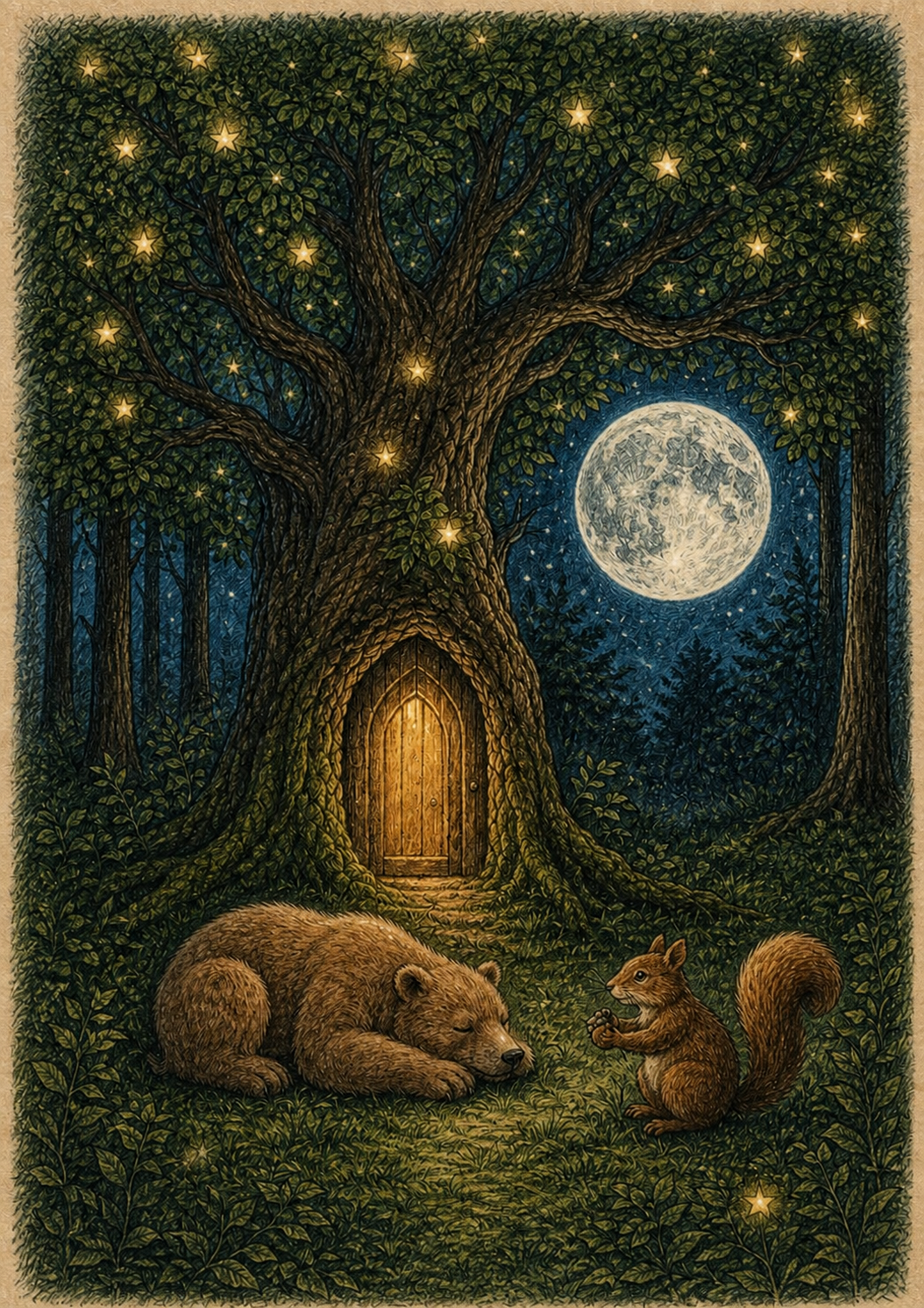
The train had grown unusually quiet, so quiet, in fact, that the steam itself seemed to hum in a lower key, like a lullaby wrapped in moss. That’s when Bearton Rogers, who had mostly listened, mostly pondered, and mostly sipped tea on this strange journey, leaned back and said: “Mind if I tell one?”
Bob blinked, once, slowly, then gave a small approving nod, his philosopher’s beret tilting just so.
Bearton’s paws folded together, then opened, like a storybook. “You know, back where I’m from, in the Enchanted Forest,” he began, “we didn’t have many books. But we had trees. And the trees are kind of like books. They know stories, and at night when the forest grows quiet, they whisper them.” He paused. “There was one tree in particular … the oak. Not just any oak, mind you, the Oak. We called it Duir. They say that name meant ‘door,’ and not just a door in the wooden sense, but a passage. Between the worlds.”
Bob tilted his head as if suddenly the rhythm of the train had shifted.
Bearton continued, his was voice soft, like fur brushing against bark. “I remember sleeping under that tree. Every bear cub did. It was a rite of passage. You weren’t truly part of the forest until you had dozed off beneath Duir and dreamt the dream.”
“What dream?” Bob asked, finally.
Bearton’s gaze drifted toward the window. “The one where time forgets you,” he said. He smiled and continued: “When I go back to my cabin at night, I still dream I’m under that tree. The breeze smells like moss and something older. And I swear, I can hear my name spoken not by a voice, but by the soil.”
Bob blinked slowly.
“Then I wake up,” Bearton added, “and I’m back on this train. Chugging toward Elsewhere. Wearing a coat. Drinking tea.”
He leaned back in his chair. “Everyone in the forest knew that tree. And no one ever cut it. Not even the beavers.”
Bob finally purred. “Well, that is saying something.”
They sat in silence for a while. Duir. The Door. Bearton closed his eyes just for a moment. And in that moment, he was back under the cosmic oak. He then cleared his throat with a nostalgic grumble. “The Cosmic Oak was old as longing. Taller than thunder. Some say it whispered before language existed. Some say it is the language.”
Bob’s ears flicked. He fell silent for a moment. The flickering train light dimmed. Bob squinted at the window, his philosopher’s beret slightly askew, tapped the glass once, then looked at Bearton. “That door,” he said, “what’s it for?”
Bearton didn’t look up from his cup. He just said, “It’s a portal.”
Bob narrowed his golden eyes. “Portal to where?”
Bearton finally turned and smiled that slow, sap-thick smile he reserved for ancient things. But didn’t reply.
Bob squinted harder: “To where? The Land of Excessively Symbolic Trees?”
Bearton reached into the worn brown coat that smelled faintly of moss and peppermint tea, and from the depths of some impossible inner poket, he pulled out … an acorn. He held it up solemnly: “this,” he said, “is the key.”
Bob stared. “That? That’s a snack.”
Bearton leaned in with a glint in his eye and said, “You know, they say from tiny acorns mighty oaks grow …” then added, “but they never mention the ones who try to help the forest economy by hoarding acorns.”
“That,” Bob added with a gleam in his eyes, “was a very serious investment joke.”
Bearton felt proud, yes, but also relieved. Proud because he’d finally answered one of Bob’s endless questions without spiraling into existential rambling. Relieved because, truth be told, he’d carried that acorn for so long he’d almost convinced himself it was just a sentimental snack.
Bob blinked twice. “Good story,” he said, then added, “for a bear.”
Just then, the train gave a polite rumble, and for a second, the trees outside shimmered like they’d heard the joke and approved.
Continue the journey
Enjoying The Train to Elsewhere?

Leave a comment