
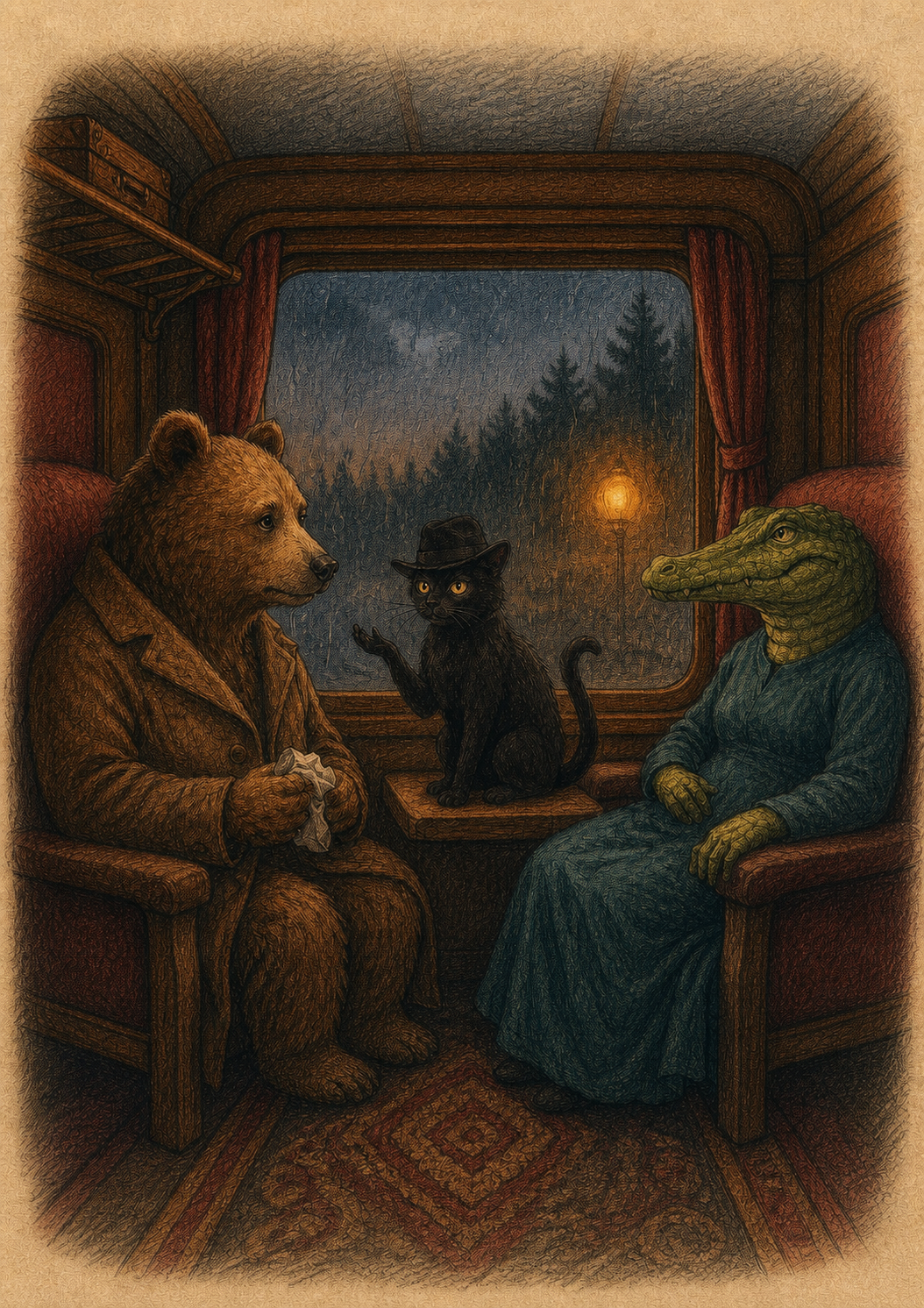
The Train to Elsewhere had just passed a tunnel shaped like a jawbone. Bob was perched on a small table beside the rain-speckled window. Suddenly, he folded his newspaper and gave Bearton a long, deliberate look. “Bearton? Have I ever told you the story of the Torch of Amber?” he asked, flicking his tail once.
Bearton, who had just unwrapped a honey-glazed sandwich and was debating whether to eat the crust first or last, paused mid-bite. “No, Bob,” he said, blinking slowly. “But I have a feeling you’re about to.”
Bob tilted his head, as if listening to some frequency only he could hear and stated: “All righty then, I’ll tell you the story, if you insist.” He continued, but this time slowly and rhythmically: “Long ago, before Elsewhere had tracks or timetables, and mind you, it means a very long time ago. Before calendars, before even the kingdoms, when the stars still argued over who would be the North and who the South, there lived a boy who wanted to be more than a mortal. His name was Phaëthon.
“Phaëthon was the son of a water nymph, Clymene. One day, his mother told him that his father, the mighty Helios, was a god who drove the sun chariot across the sky every day. The boy got excited. But boys are rarely satisfied with stories. So Phaëthon burned with a hunger that only certainty could nourish. He wanted light in his hands, just like his father. But above all things, he wanted to be seen.
“So, he went east, to the edge of the world, where the morning sun waited behind golden gates and his father’s palace was roofed with fire. Helios, reluctantly proud, swore by the River Styx, the only oath a god cannot break, that he would grant the boy anything he wished. And Phaëthon asked to drive the chariot of the sun.”
Bob paused and licked a paw, as if steadying the atmosphere, before continuing: “A terrible idea, if you ask me. But you know how these old myths go. Pride and parenthood rarely mix well,” Bob murmured and continued: “The horses of the sun were wild things, born of flame and chaos, and their names were long lost to ash. Even the gods could barely hold them.
“Phaëthon climbed into the sky with the reins of flame in his hands. But he couldn’t contain the horses. He soared too high, freezing the heavens, and then too low, scorching the earth. Chaos unfolded. The seas boiled. The deserts were born. And so, to save the world, Zeus struck down the chariot with a lightning bolt.
“The boy fell into Eridanos, a river no one can find on any map. His sisters, the Heliades, ran to the riverbank. They tore their hair. They wept and wept. The gods moved or annoyed, I’m not quite sure, transformed the sisters into poplar trees. And their tears, falling from bark into river water, became amber. Not at once. It took time. Years. Grief always takes time to become beautiful. But it did. With time, it turned golden, warm, and strangely alive. Amber.”
Bearton sat in silence, as if the river was rising inside him, feelings overflowing. “So,” he said slowly, “amber is sorrow?”
Bob gave a faint purr and replied: “Amber is memory hardened by grief.”
Bearton glanced out the window: “But how does that become a torch?”
Bob’s ears twitched: “Well, the story isn’t finished yet,” he said and continued: “Some centuries later, a philosopher-poet, name long forgotten, though I like to call him Eliados, came across a piece of that very amber. He carried it with him. Rubbed it while writing. Slept with it under his pillow. And with each year, the amber absorbed more than a touch. It absorbed longing and memory. Eventually, it began to glow, as if it had remembered the sun, or Phaëthon’s fall. They say when Eliados died, the amber floated above his chest, still glowing faintly. It was now a torch.”
Bob looked at Bearton with soft eyes.
Crocodama, lounging nearby scoffed: “Tears don’t become torches. They evaporate.”
Bob tilted his head and replied: “Only when no one remembers love.”
And the train rolled on.

Leave a comment