
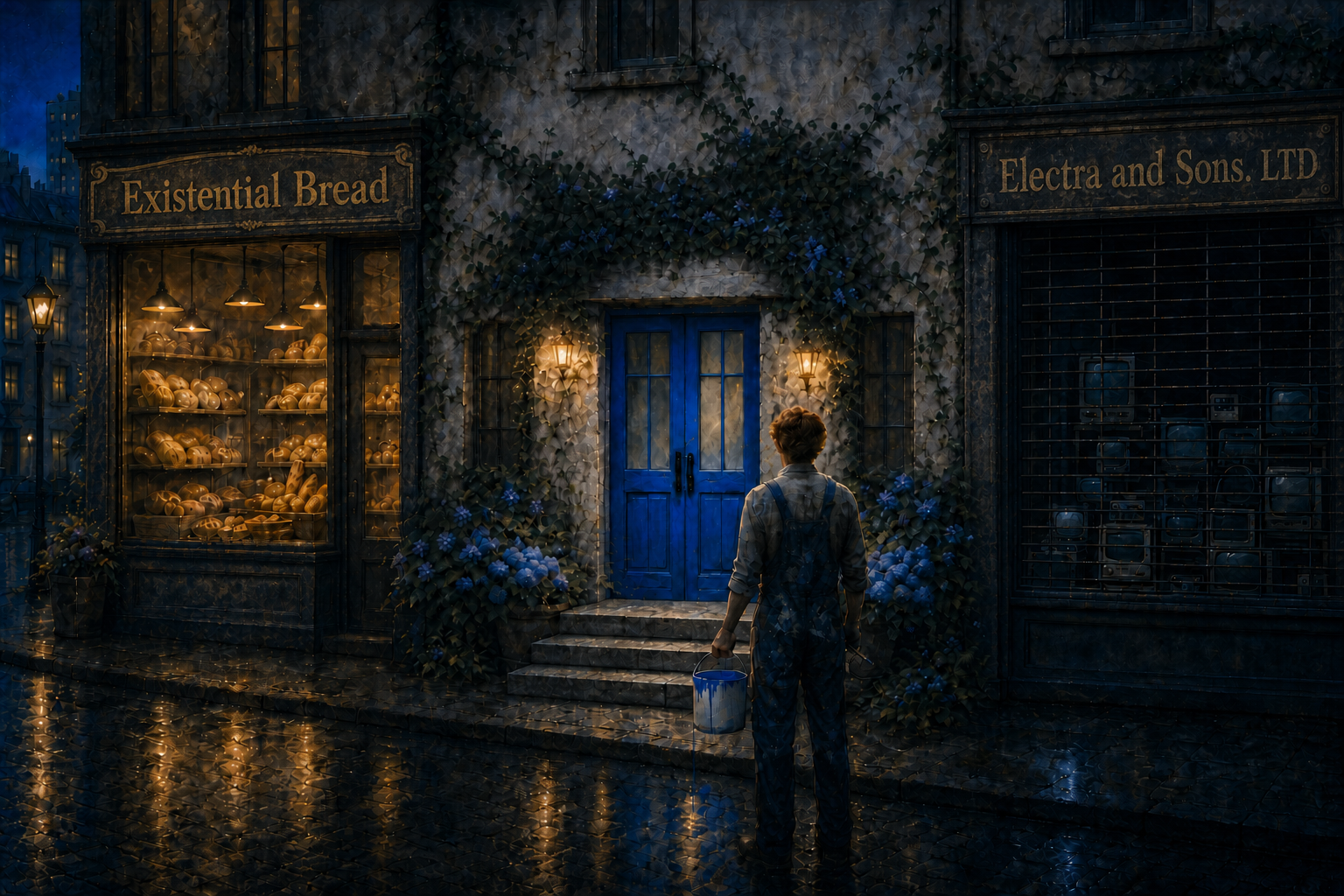
No one planned for the clinic to be blue.
It happened by accident, or by mistake, depending on who tells it.
The story goes like this:
There was an abandoned house on a street no one walked at night, although it was in the middle of a busy city.
The windows were always dark. Not shattered, just dark, as though light refused to enter.
Even the sun seemed to pass around it, like water splitting around a stone.
When renovations began, the workers noticed something odd.
Every morning the walls were a little damp, but only at the lower edges, as if the rooms were breathing in the night.
They blamed old pipes, air humidity, the usual explanations that get used when no one wants to say aloud that something feels wrong.
Then the painter arrived.
He was a quiet man, not mystical, not superstitious—the kind who does his job with steady hands and never looks long at anything he doesn’t need to see.
He arrived early in the morning carrying five paint cans, all white.
At least that’s what the labels said.
He opened the first can and froze.
The paint wasn’t white.
It was a cold, tidal blue, like deep water seen from below, or the color of a memory that hasn’t surfaced yet.
He tried again with another can.
Blue.
He assumed the label was wrong.
He opened a second can.
Same blue.
All five cans were blue.
He called the supplier. They insisted the entire batch was white.
So he painted anyway, because the air in the room felt peculiar, and he wanted to finish quickly and leave.
But the more he painted, the quieter the room became.
Not peaceful quiet—a heavy quiet, like the silence after something has been carried away.
And then he heard it.
A faint sound behind the walls.
Not pipes. Not wind.
A slow, rhythmic noise, like water moving through a narrow place, or someone breathing from very far away.
He stepped back, brush in hand, and the sound stopped.
He dipped the brush again and kept painting.
The sound returned.
He felt watched, not by a presence, but by the room itself—as though the walls had been waiting for paint, waiting for color, waiting to become something.
When he finished one wall, the blue deepened on its own, darkening at the edges, softening in the center.
It looked like a shoreline seen at night—where the sky sinks into water and everything becomes one continuous darkness.
When the owner arrived, the painter apologized, ready to return the rest of shipment.
But the owner—tired, overwhelmed, and not prone to sentiment—looked at the color and said quietly:
“Leave it.”
The painter left the room without cleaning up.
He closed the door quietly.
And he didn’t come back.
He left the house half-finished, believing he’d ruined someone’s project.
People say the clinic chose its own color.
They say it happened before its name, before anyone imagined it would become a place where people came to find themselves.
Later, when the clinic opened, people who entered the room would pause without knowing why.
Some said the room felt like standing near the ocean, even though the building was miles inland.
Others said it felt like being underwater but still breathing.
A few guests reported something stranger—the sense that the walls were listening.
Not intruding.
Just waiting.
Some felt comfort.
Some felt exposed.
All felt seen.
The color stayed.
No one tried to repaint it.
Because everyone who entered knew, without discussing it, that the clinic had chosen the blue for a reason.
And whatever lived beneath that color: tide, silence, memory, something older and slower than language—was not to be disturbed.

Leave a comment