
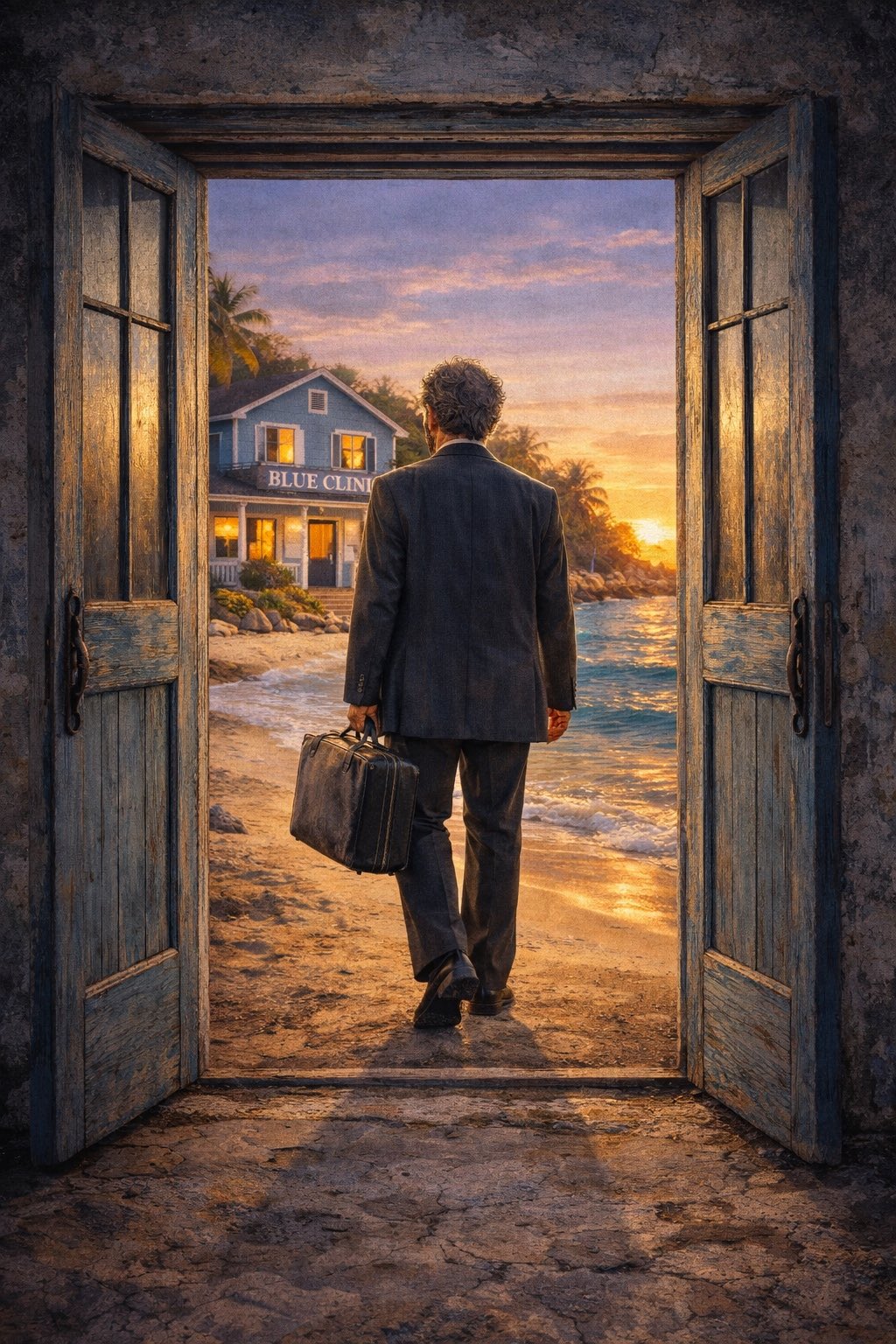
He was not looking for a door. He was looking for a way to make sense of a sentence he had heard too many times: I don’t know why I’m so tired.
He had spent decades listening to variations of it. In offices with framed diplomas. In hospitals where clocks were too loud. In rooms designed to contain suffering without absorbing it. He had learned how to listen carefully without drowning.
On one otherwise usual morning, he noticed the blue door in the middle of the city. He was already late. Late for a lecture on resilience. Late for a panel about burnout. Late for a life that had begun to feel like a case study he could no longer finish writing.
The door stood between a bakery and a closed electronics store. Blue. Unremarkable. Waiting.
He slowed without meaning to. That was unusual. He prided himself on forward motion. On functioning. On the ability to compartmentalize curiosity until weekends that never arrived. Yet something in front of that door caused his urgency to misfire—not collapse, just misalign.
He touched the handle. It was cool. Solid. Ordinary.
One step. Salt replaced exhaust. The city released him without complaint.
He stood on sand, shoes already damp, briefcase absurdly out of place. The wind moved without asking permission. The sea repeated itself with the calm authority of something that had never needed to justify its method. Ahead, the building waited.
He assumed—briefly—that this was dissociation. A stress response. The brain improvising relief. He catalogued the sensation professionally. Transient spatial distortion. Likely fatigue-induced. Still, he walked.
The building did not present itself as a clinic. No signage. No reception desk visible from outside. Yet it said Blue Clinic. It reminded him of hospitals before they learned how to market hope.
He stepped inside.
Inside, nothing happened. Which, he realized with a faint unease, was the point. No intake forms. No diagnostic posture. No pressure to explain why he had come or whether he intended to stay. The light rested where it fell. The rooms were patient without being passive.
He sat. Minutes passed. Or hours. Time did not assert itself. For the first time in years, no one asked him to translate suffering into language. No one needed insight. No one required interpretation.
He noticed something unsettling. His body was ahead of his thoughts. His shoulders dropped before he understood why. His breath lengthened without instruction. The clinical reflex—the need to frame, to assess, to intervene—failed to activate.
This disturbed him more than panic would have. He had built his life on the assumption that awareness preceded change. That understanding was the lever. Here, change occurred without explanation. Without narrative.
He stayed the night. Then another.
He attempted to leave on the third day. He truly did. Walked back toward the shoreline, certain that if he kept moving the city would reassert itself. It did not. The path rearranged politely. Grass replaced memory. Driftwood suggested direction without enforcing it.
He returned to the building without surprise and decided to remain there.
Over time, others arrived. Not in waves. Not predictably. They appeared the way symptoms do—quietly, individually, without announcement. Some spoke. Some slept. Some stared at the sea as if waiting for a permission they had never been granted elsewhere.
He did not treat them. He noticed them. That distinction mattered.
When someone asked what kind of place this was, he found himself answering honestly for the first time in his career.
“I don’t know,” he said. “I’m just… still here.”
Years passed. Eventually, someone asked his name. He hesitated. Names had weight. Authority. History. He had spent a lifetime being addressed correctly and still misunderstood. But here, it felt safe to answer.
“Dr. Mitsubishi,” he finally said, and added: “Dr. Mitsubishi of Elsewhere.”

Leave a comment