
Chapter One: Replacement
A story in four connected chapters.
Kafka wrote about men becoming insects, trials without crimes, castles without entrances, and authorities nobody could quite locate.
But he never wrote the obvious book.
The Cat.
Bob considered this an unacceptable oversight. So he decided to write it himself.
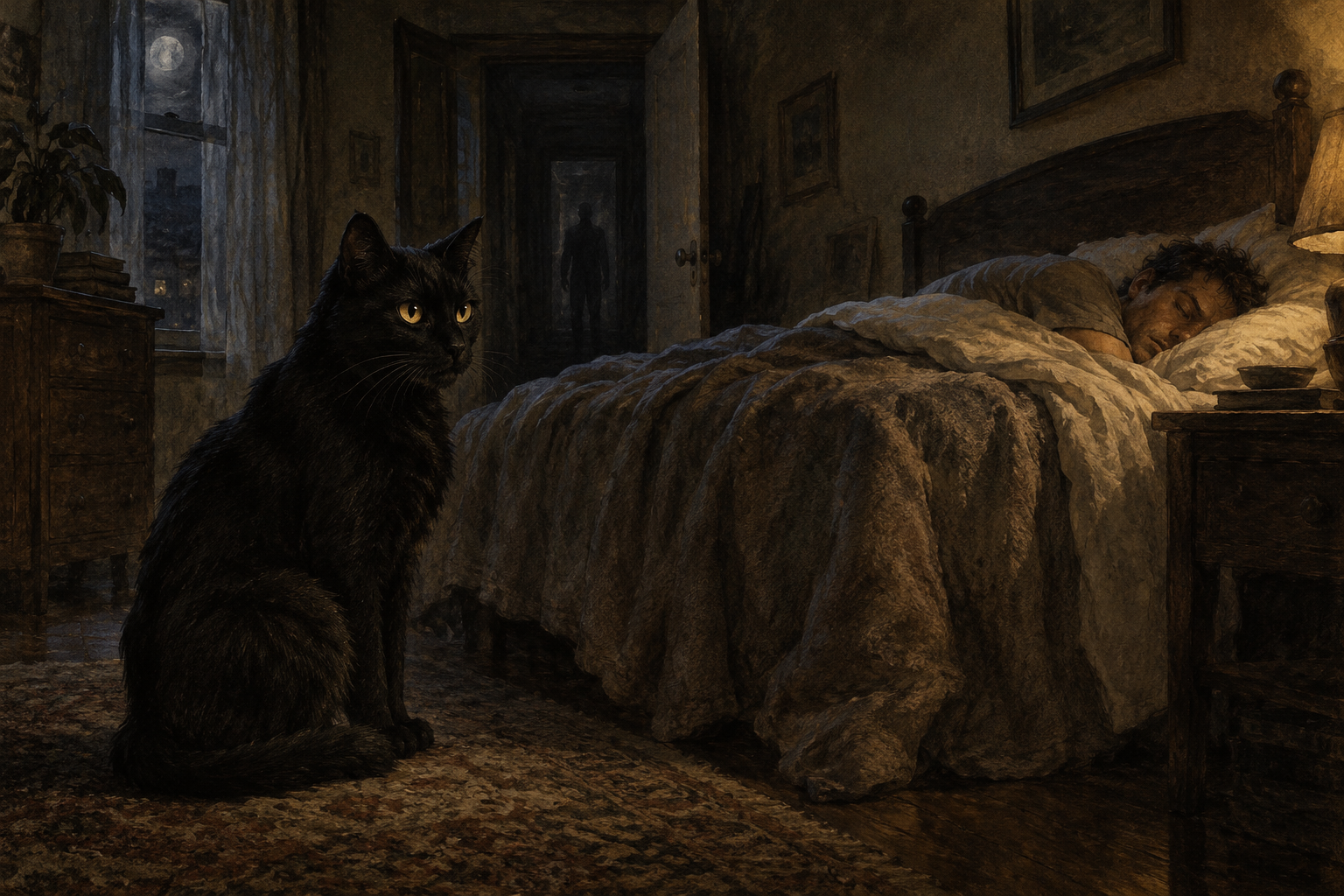
His story begins with a man waking at three in the morning to find a black cat sitting beside his bed.
“Who are you?” the man whispers.
“You know.”
“I don’t.”
“That is why I’m here.”
The following morning, the man discovers a new door in his apartment. Behind it is his bedroom.
Inside the bedroom, he is asleep.
The cat is sitting beside him.
Watching.
The man closes the door. Another appears. He opens it.
Same room. Same sleeping man. Same cat.
Except this time the cat turns toward him.
“You’re late.”
“For what?”
The cat looks toward the sleeping version of him.
“Your replacement.”
The man stares at himself sleeping.
“He’s replacing me?”
The cat blinks.
“No.”
“Then who is he replacing?”
“You.”
“That’s what I just said.”
“No.”
The sleeping man opens his eyes. He sees the man standing in the doorway.
And screams.
“What is he afraid of?” the man asks.
“You.”
“Why?”
“Because yesterday he was you.”
The man looks back at the cat.
“I don’t understand.”
“You never do.”
“How many times has this happened?”
The cat looks toward the corridor. There are hundreds of doors now. From behind each one comes the faint sound of someone waking.
“Enough.”
The man begins opening them. In every room, another version of himself is asleep.
Some are younger. Some impossibly old.
One room is empty except for the indentation of a body on the mattress.
Another contains only the cat.
“Which one is the original?” the man asks.
The cat begins washing its paw.
“That question is why you keep getting replaced.”
“By whom?”
“By the version of you that still believes there was an original.”
The man stops. Behind him, his bedroom door closes.
He tries the handle. Locked.
Someone on the other side whispers:
“Who are you?”
The man suddenly remembers asking those exact words.
I look up from Bob’s manuscript and turn toward him.
“Bob, what kind of book are you writing?”
Bob continues typing.
“The one Kafka forgot.”
“Does it have an ending?”
Bob stops.
He looks at me, then at the reader.
“It did.”
A page turns somewhere. Neither of us is holding the book.
I look down.
There is a sentence on the page I don’t remember Bob writing:
THE REPLACEMENT WILL EXPERIENCE CONTINUITY. THIS IS NECESSARY.
“Bob?”
He reads it.
For the first time, he looks concerned.
“What?”
“That sentence wasn’t there before.”
Another line appears beneath it.
THE CAT IS NOT PART OF THE REPLACEMENT PROCESS.
I exhale.
“Well. At least you’re safe.”
Bob stares at the page.
A final sentence begins typing itself.
THE READER IS.
Bob slowly looks at me.
Then past me.
At you.
“Oh,” he says.
“What?”
“You’re late.”
Bob turns back to the manuscript. On the next page, the story begins again.
Chapter Two: Not Yet
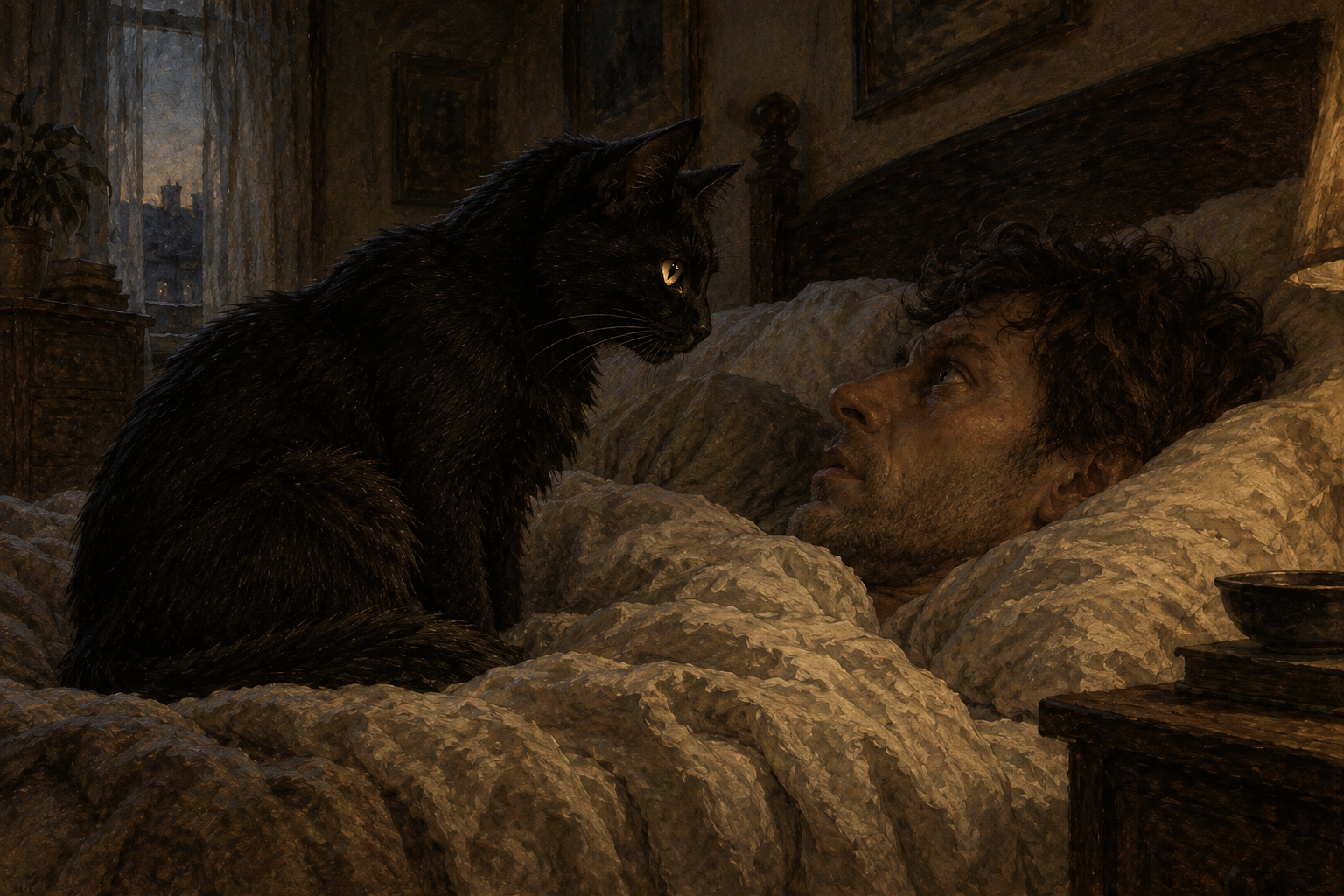
The cat had been in the room for three nights before the man understood that it was watching him sleep.
He could not remember letting it in. This troubled him less than the fact that, each morning, it was sitting in a different place.
The first morning, at the foot of the bed. The second, beside the door. The third, on the pillow beside his head.
It was a black cat with enormous golden eyes. During the day it behaved almost normally. It ate. It slept. It washed its paws with meticulous indifference.
Only at night did it watch him.
On the fourth morning, the man woke before the cat expected him to.
Its face was inches from his own.
Neither moved.
Then the cat whispered:
“Not yet.”
The man did not sleep again.
At dawn, he discovered a second toothbrush in his bathroom. By noon, there were two coats hanging by the door.
That evening, he found photographs on his phone of places he had never visited.
He was in every one of them.
In the final photograph, he was asleep in his bed. The photograph had been taken from the spot where the cat usually sat.
He enlarged it. Something was standing in the hallway behind him.
It had his face.
The man slowly looked toward the cat.
“What does it want?”
The cat continued washing its paw.
“Your turn.”
Chapter Three: The Other Tenant
By morning, the second coat was gone. The toothbrush remained.
The man stood before the bathroom mirror holding it between two fingers.
It was wet.
He had not used it.
He opened the medicine cabinet. There were two bottles of aspirin, two razors, two identical tubes of toothpaste.
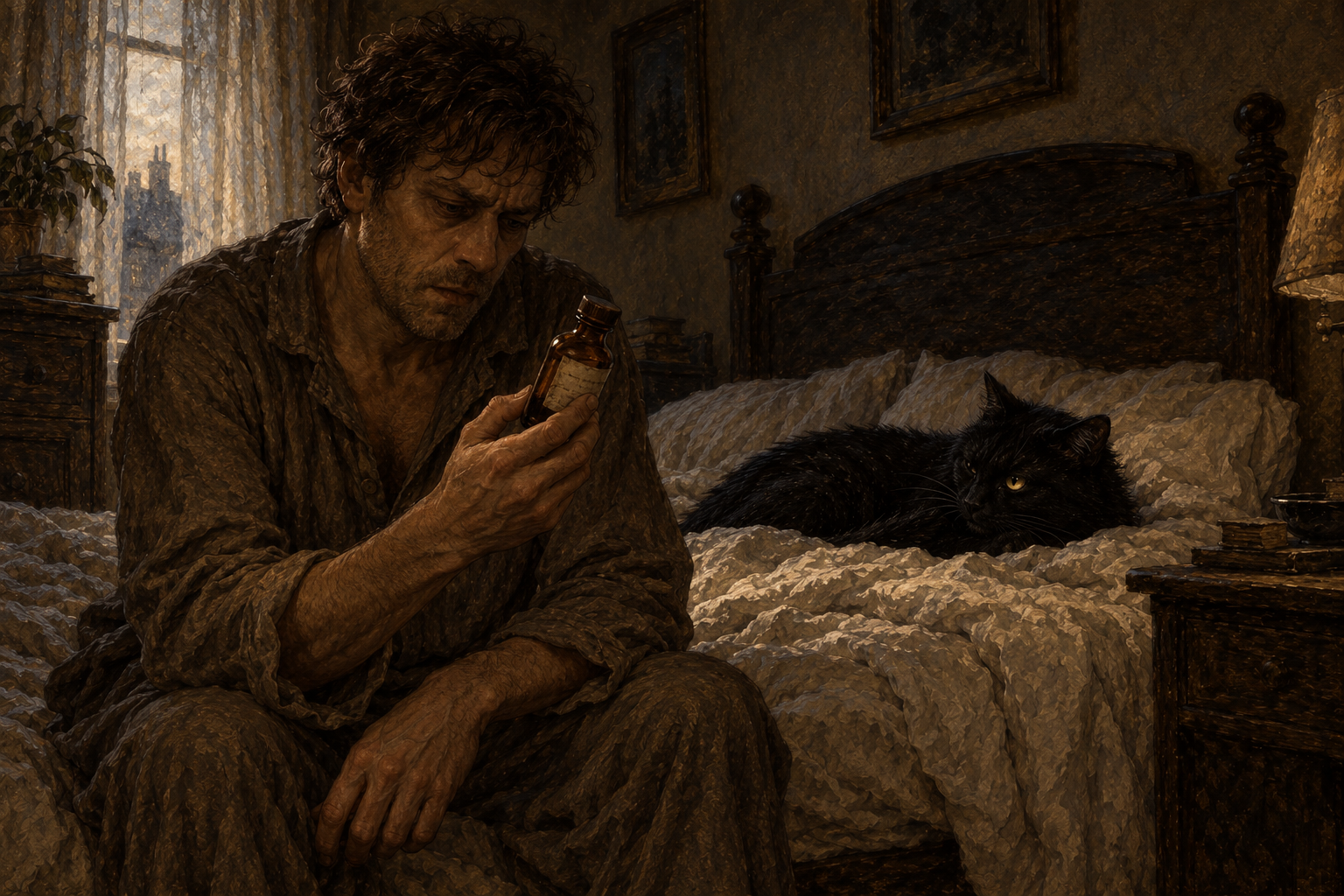
Behind them stood a small brown bottle he had never seen before.
His name was printed on the label.
Beneath it:
TAKE ONCE DAILY UNTIL YOU REMEMBER.
There was no physician’s name.
He carried the bottle into the bedroom. The cat was asleep in the exact center of the bed.
“Wake up.”
One golden eye opened.
“What is this?”
The cat looked at the bottle.
“Medicine.”
“I can see that.”
“Then we’re making progress.”
“Who put it there?”
The cat closed his eye.
The man shook the bottle.
Something moved inside.
Not pills.
Something softer.
He set it down.
“I want you out.”
The cat opened both eyes.
“Out where?”
“Out of my apartment.”
The cat sat up. For several seconds, he appeared to consider the request seriously. Then he looked toward the bedroom door.
“This isn’t your apartment.”
The man laughed. It was an ugly little laugh, produced mostly because the alternative was asking what the cat meant.
“I’ve lived here for eleven years.”
“No.”
“I have.”
“You remember living here for eleven years.”
“What is the difference?”
The cat stepped from the bed. He walked into the hallway. The man followed.
At the front door, the cat stopped. There were two locks. The man had always had one.
Below them was a brass nameplate. He leaned closer.
Two names were engraved upon it.
The first was his.
The second was also his.
He touched the letters. They were cold.
“That wasn’t there yesterday.”
The cat looked up at him.
“You say that a lot.”
The man tore the plate from the door. Behind it was another.
Same two names.
He pulled that one away.
Another waited beneath it.
Then another.
He stopped.
“How many of me live here?”
The cat’s tail moved once.
“Currently?”
The man stared at him.
From somewhere above them came footsteps.
Slow. Barefoot. Crossing the ceiling.
The man looked up.
“There is no apartment above mine.”
“I know.”
The footsteps stopped. Directly overhead.
Then came three knocks.
The man did not move.
Three more.
He whispered, “What does it want?”
The cat’s ears tilted forward.
For the first time since arriving, he seemed genuinely interested.
A voice came through the ceiling.
The man’s own voice.
“Bob?”
The cat looked up.
The voice spoke again.
“Bob, don’t let him open the door.”
The man slowly lowered his eyes.
“What door?”
Behind him, something clicked.
He turned.
There was a door at the end of the hallway.
It had not been there a moment before.
Bob sat down. His tail curled neatly around his paws.
“Now,” he said, “we find out which one of you I was sent for.”
Chapter Four: The Man Before You
The man did not open the door. For a long time, neither he nor Bob moved.
The footsteps above them had stopped. The other voice had stopped too. Only the clock in the kitchen continued ticking, although the man was fairly certain he did not own a clock.
“Tell me about him,” he said.
Bob looked toward the ceiling.
“Which one?”
“The man upstairs.”
“He isn’t upstairs.”
“You know what I mean.”
“Yes.”
“Is he me?”
Bob considered this.
“He was.”
The man sat on the floor opposite him.
“What does that mean?”
“It means he remembers your mother.”
“So do I.”
“He remembers breaking his arm when he was eight.”
“I broke it falling out of a tree.”
“He remembers the branch giving way.”
The man stared at Bob.
“He remembers your first apartment. Your first kiss. The smell of your father’s coat. The song you listened to the night you decided not to die.”
The man’s face changed. He had never told anyone about that night. Not even afterward.
Bob continued.
“He remembers standing in the kitchen three weeks ago and wondering whether his life belonged to him.”
The man swallowed.
“I did that.”
“I know.”
“So he has my memories.”
Bob’s ears moved slightly.
“No.”
The man waited.
“You have his.”
The instruction on the bottle returned to him: until you remember.
Something knocked once above them. The man looked up.
“He came first?”
Bob began washing one paw.
“That’s a very human way of arranging things.”
“Did he live here before me?”
“Yes.”
“For how long?”
“Eleven years.”
The man tried to laugh again, but this time nothing came out.
He looked toward the front door. The coats. The locks. The names beneath the names.
“What happened to him?”
“He noticed me.”
The man slowly turned back.
“What?”
“He woke one night and found me beside his bed.”
The man’s mouth went dry.
“What did he say?”
Bob stopped washing.
“He asked who I was.”
The man felt something cold move through him.
“And what did you tell him?”
Bob looked directly at him.
“You know.”
The man stood.
“No.”
“You asked the same questions.”
“No.”
“You made the same arguments.”
“Stop.”
“You found the same toothbrush.”
“Stop.”
“You sat exactly where you’re standing now.”
The man stepped backward. Bob watched him.
“And then?”
“You opened the door.”
The man looked down the hallway. The new door remained there. Dark wood. Brass handle.
Waiting.
“What happened when he opened it?”
“He found you.”
Silence.
The man looked at Bob.
“Where?”
“Asleep.”
The bedroom suddenly seemed very far away.
“He found me sleeping in his bed?”
“In your bed.”
“You just said it was his.”
“It was.”
The man pressed both hands against his face.
“This makes no sense.”
“It made sense to him.”
“What did he do?”
Bob’s expression changed almost imperceptibly.
“He watched you sleep.”
“For how long?”
“Three nights.”
The man lowered his hands. Three nights. The cat had been in his room for three nights before he realized that it was watching him sleep.
“Bob.”
“Yes?”
“Were you watching me?”
“No.”
The man felt his stomach tighten.
“Then who was?”
A faint sound came from the bedroom. The mattress creaked.
Bob looked toward it. The man did not. He already knew what he would see.
Someone was sitting on the edge of the bed.
Breathing.
His breathing.
“Why didn’t he wake me?”
Bob’s voice became very quiet.
“He did.”
The man turned. At the end of the hallway stood another man. Barefoot. Pale.
His face.
Not older. Not younger. Exactly his.
The other man looked exhausted. He looked at Bob. Then at the man.
“I told you not to let him open the door.”
“I didn’t,” Bob said.
The other man’s face emptied.
Slowly, both men looked toward the new door. The handle was turning.
From the other side came a voice.
Their voice.
“Bob?”
Bob’s tail stopped moving.
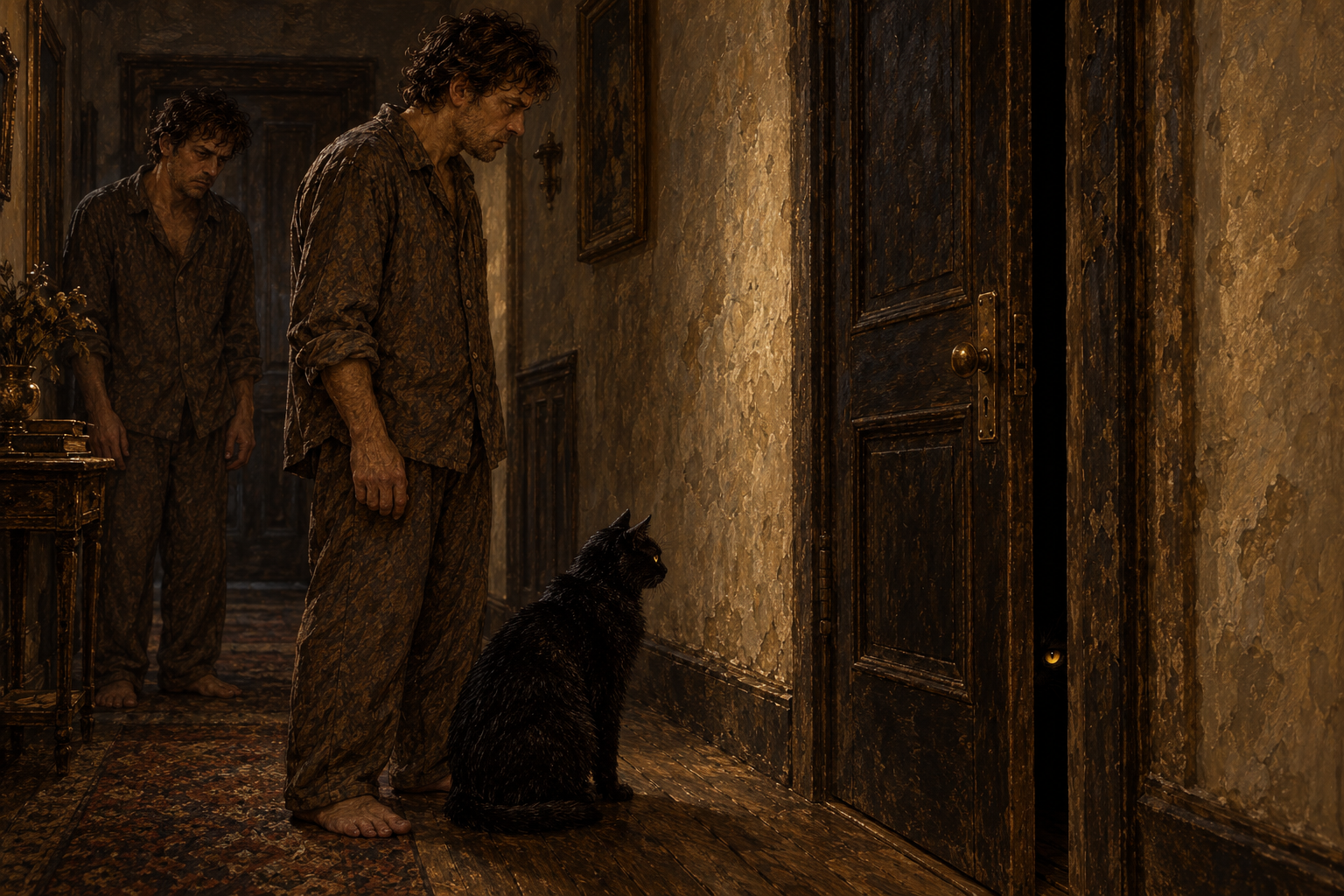
The door opened a fraction. A golden eye appeared in the darkness.
The man looked down at Bob. Then back at the eye.
“Bob?”
The cat beside him did not answer.
From behind the door came a soft purr.
And then:
“Which one?”

Leave a Reply