
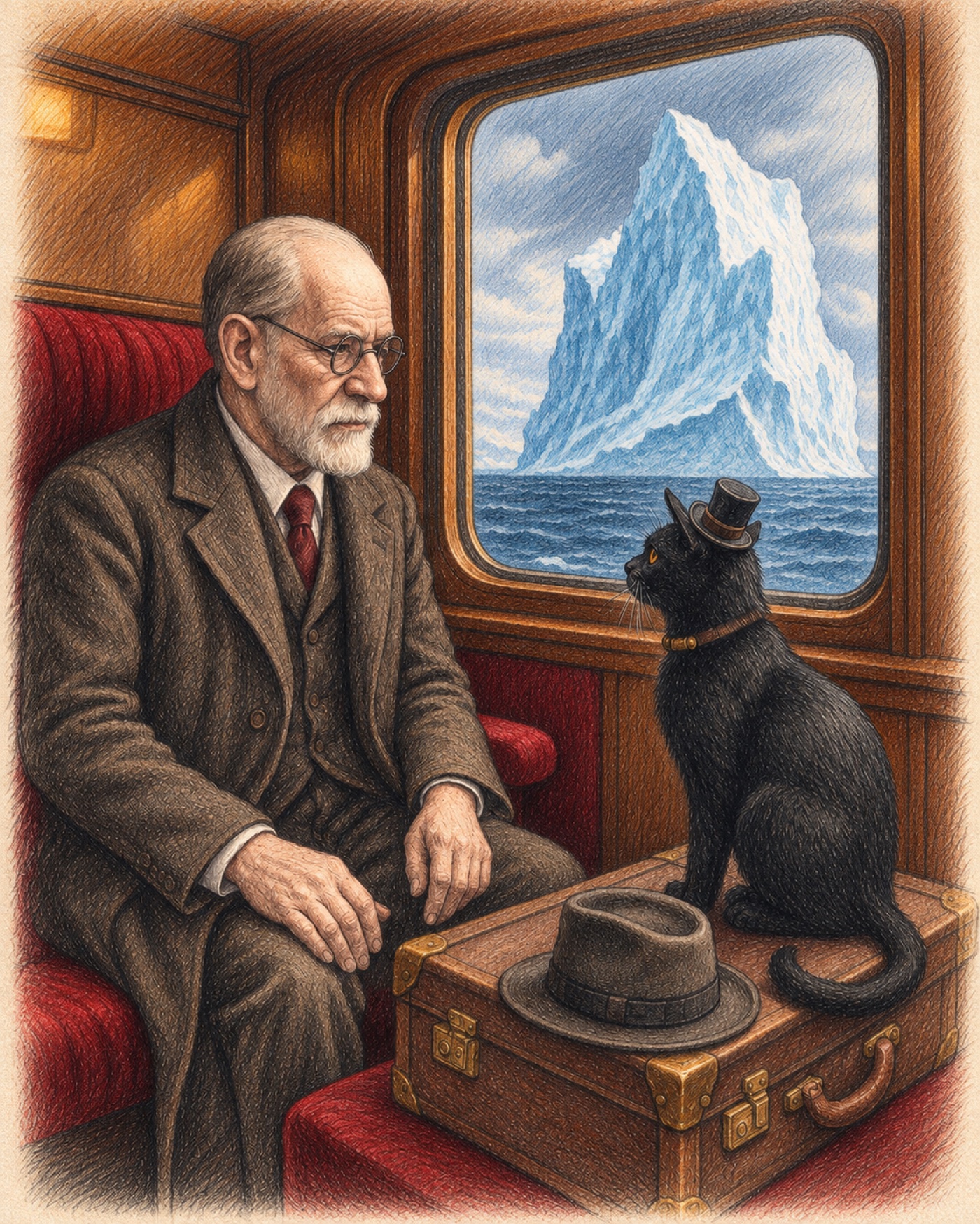
The train rattled gently through a corridor of ice and dream. Outside the cabin window, an enormous iceberg drifted across the shimmering horizon like a repressed memory breaking the surface of consciousness. The sunlight bent at odd angles, as if avoiding eye contact. Inside, the cabin smelled of old cigars, faint violets, and curiosity.
Dr. Sigmund Freud, cloaked in a thick wool coat with a faint ink stain on the sleeve, sat upright in a crimson velvet armchair. His eyes were half-closed in thought but not in sleep. Or at least, that’s what he thought.
Freud had often traveled by train between Vienna, Paris, and Berlin. Especially in the period between 1885 and 1886 when he studied in Paris under Jean-Martin Charcot, researching hysteria and hypnosis.
This time around, he was on the train back to Vienna, reflecting on the psychological origins of hysteria, departing from purely neurological explanations. And his mind was quietly contemplating the topographical map of the human mind.
“The hysteric suffers mainly from reminiscences,” Freud concluded loudly, then ordered a cup of tea from a conductor passing by and gently inquired regarding the estimated time of arrival.
Then he looked through the window and noticed an iceberg, pale blue and unknowable, like a thought he had tried not to think for too long. Freud stroked his beard once in quiet disbelief and wondered what the iceberg was doing there. Then he looked around and pinched his arm. Was he awake or was he asleep? A doubt crossed his mind.
Suddenly, Bob the cat leapt silently from the luggage rack and perched on his suitcase. The cat’s tail was curled like a question mark.
It had a miniature telescope hat strapped to his head and was giving off an unusually friendly vibe for a cat, Freud thought. Then suddenly out of nowhere, the cat began talking: “The glaciers are melting. We are becoming increasingly unconscious, Doc, ha? What’s your take?”
Freud stroked his beard once. Again. Bob licked his paw now with a calculated detachment.
“Tell me, Herr Katze,” Freud began in his slow Austrian rhythm: “Do you dream?”
Bob blinked once: “Well, of course. I chase unresolved childhood through walls of linguistic ambiguity.”
Freud chuckled with his eyes twinkling behind his spectacles and thought to himself: “This happens to be my kind of cat!” And replied right back: “A symbolic chase, then. Classic displacement. Your dreams may be more human than I suspected.”
Bob tilted his head. “And yours, Doc? Still dreaming of trains in tunnels and umbrellas in the wrong places?”
“Ja, ja,” Freud sighed. “Sometimes the train is just a train. But sometimes …” Freud paused and then continued: “it is a great metaphor for repression.” Then he tapped the frosted window. “And that iceberg, floating alone,” he added, “it reminds me of the unconscious. Nine-tenths hidden, terrifying, and violent.”
Bob purred, “And the passengers?”
“Ah,” Freud leaned closer, lowering his voice to a whisper, “They’re all trying to reach …” Then suddenly he paused, realizing the absurdity of having to explain his theories to a talking cat, and stroked his beard. This time, twice.
Bob took over the conversation: “They’re all trying to reach Elsewhere, Doc, but no one knows what they’ve left behind.”
Bob hopped down and curled into Freud’s lap like a warm contradiction. Freud didn’t answer right away. He simply watched the iceberg with his eyes narrowed, not in skepticism, but in deep reflection.
“This cat,” he finally thought, “is unlike any domestic creature I’ve encountered. More sphinx than pet.”
Bob, meanwhile, tilted his head toward the glass, listening, not just to Freud, but to the icy waters below the iceberg. And then suddenly, a phrase fluttered through his mind like a paper moth: “Time spent with cats is never wasted.”
Bob twitched an ear. Had Freud said it? Or had he simply thought it? He looked over, but the old man remained still as ever.

Leave a comment