
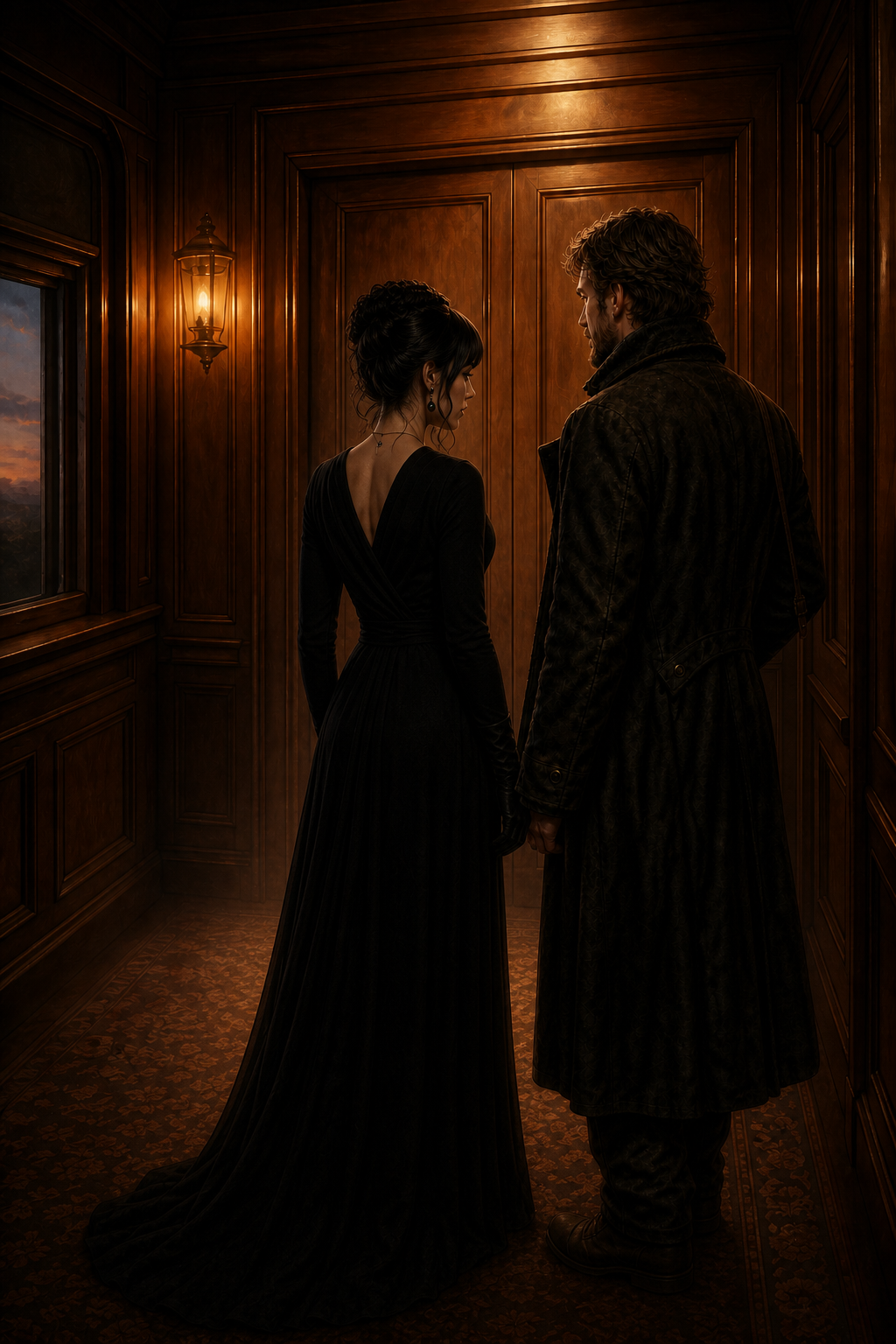
“You’re early,” says Lady Marmalade.
“I tend to arrive before rules,” Gurgeh replies.
She laughs warmly. “Good. Rules get nervous when they realize you’ve noticed them.”
For a moment, neither speaks. This is not politeness. This is calibration. Lady Marmalade studies him the way a cartographer studies a river, not by its banks, but by the way it refuses to stay still.
Gurgeh recognizes something immediately and relaxes.
She is not here to win.
That makes her dangerous.
“You broke a civilization with a game,” she says lightly, stirring her tea. “Or rather, you let it break itself.”
Gurgeh does not flinch. “I played. Others decided what the play meant.”
“Ah,” she says. “A classic Elsewhere defense.”
He tilts his head. “And you?”
“I design situations where outcomes can’t pretend they were inevitable.”
In that moment, Gurgeh understands her role. Not a general. Not a ruler. A strategist of conditions. She doesn’t choose winners. She arranges rooms.
Lady Marmalade slides something across the table. Not a board. Not pieces. A blank card with a faint texture, like paper that has already erased something.
“In Azad, the game proved legitimacy,” she says. “In the Culture, games prove nothing because nothing needs proving. Elsewhere sits between. We use games to reveal where certainty breaks.”
Gurgeh looks at the card. He does not touch it. “And what breaks here?”
She smiles wider. “People who believe optimization is kindness.”
Somewhere down the corridor, Bob sneezes, as if summoned by the idea.
Lady Marmalade leans back. “You’ll like it here. You’re very good at playing without believing.”
“And you?” Gurgeh asks.
She considers this. “I’m very good at noticing when belief has quietly turned into a weapon.”
The Train shifts. Not movement. Agreement.
Lady Marmalade stands. “Come. There’s a game starting soon.”
“What kind?” Gurgeh asks.
She pauses at the door, glancing back. “The kind where the goal changes if you look at it too hard.”
Gurgeh smiles. For the first time since Azad, it reaches his eyes.
He follows her.
They move together through the amber-lit corridor.
She stops before a door that does not announce itself.
“No strategies?” Gurgeh asks gently.
She touches the handle, not yet opening it.
“Oh, there are strategies,” she says. “Just not the kind that end.”
“Are you familiar with Herr Einstein?” Lady Marmalade asks, almost casually.
Gurgeh nods. Of course.
She lets the pause do its work.
“Then tell me,” she says gently, “what do you think he was playing?”
Gurgeh does not answer at once.
He thinks.
Not in images. Not in scenes. He feels for orientation, the way he always does before a move that matters. What kind of game leaves no obvious opening? What kind of move changes the board without touching it?
“He wasn’t playing for advantage,” Gurgeh says at last. “He removed the idea that anyone gets to stand in a better place than anyone else.”
Lady Marmalade waits.
“No fixed center,” he continues. “No privileged clock. No observer allowed to pretend they were outside the system. Most players try to gain freedom by escaping limits. He accepted the limits fully and forced the world to reorganize itself around that acceptance.”
“And the game?” she asks.
“Finding what stays true,” Gurgeh says, “when no one is special. When speed, position, and perspective are all relative, and consistency is the only thing that survives.”
Lady Marmalade smiles. “Most people call that theory.”
“They miss the move,” Gurgeh replies. “The move was agreeing not to win.”
Her hand rests on the door now. “That’s why you belong here,” she says. “This room isn’t for players who want power. It’s for players who can operate without it.”
She opens the door. They step forward.
The room beyond does not wait for them, and Gurgeh understands that this, too, is part of the game.
Welcome to Elsewhere.

Leave a comment