
Bob reached the edge of the Enchanted Forest during the violet hour, when daylight had not quite departed and every shadow seemed to be considering whether to stay.
The forest thinned, giving way to mountain stone. Before he saw the house, he heard the clear song of the spring.
Lady Marmalade’s little house stood like a secret made entirely of weathered stone, the kind that seemed to carry whispers from centuries before. Its roof sagged charmingly, with moss curling at the edges.
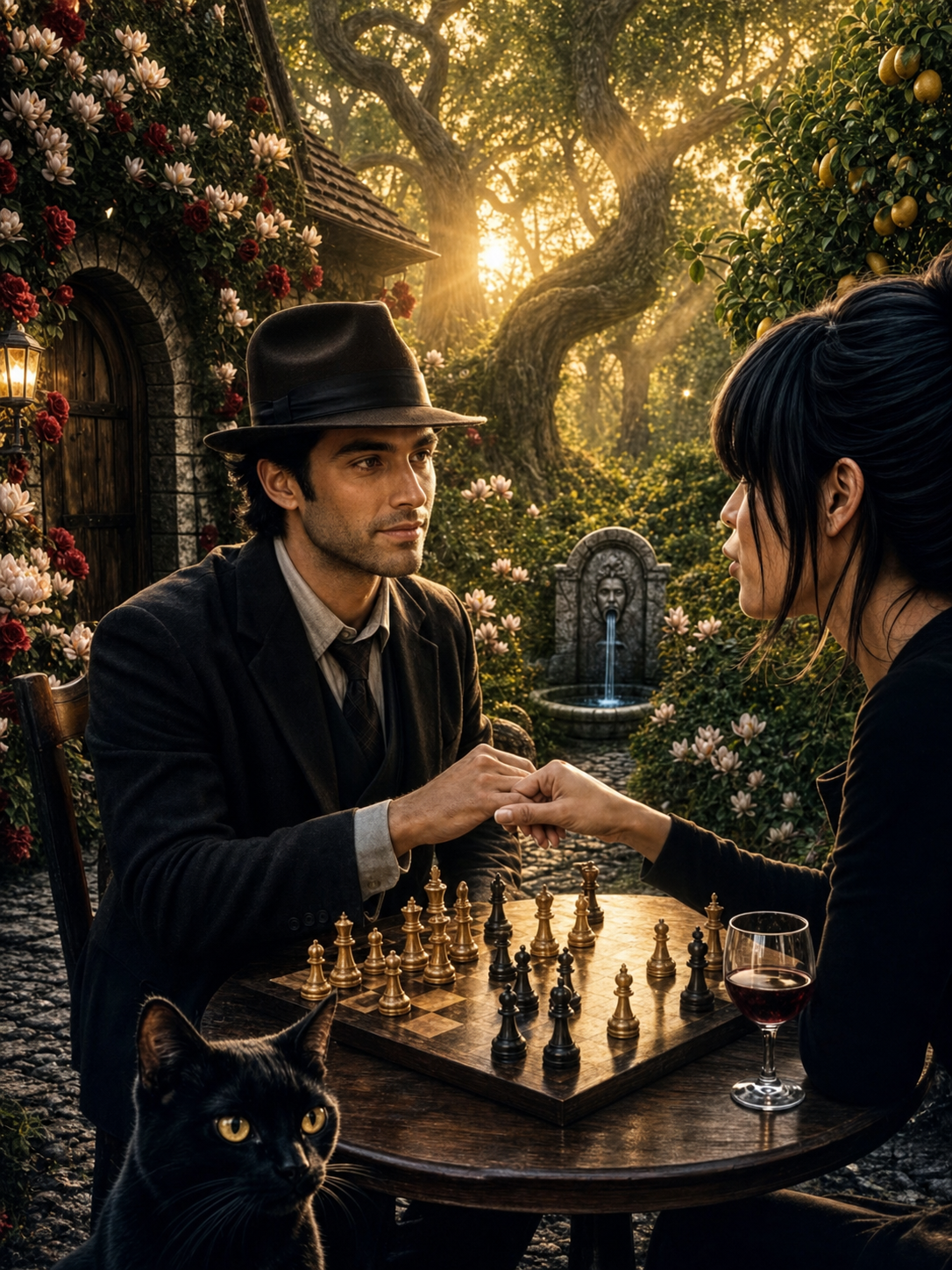
Around it bloomed an impossible garden. Red roses leaned toward magnolias. Violets rested in the shade like little stars fallen into the grass. An oak tree stood sentinel beside the house, its roots spreading wide, while a small lemon tree shook its golden fruit in the evening wind. Nearby, water ran from an old stone faucet into a shallow basin, so pure that two birds had interrupted their singing to drink.
Bob stopped at the beginning of the path.
Lady Marmalade was seated outside at a round wooden table. A chessboard stood between her and a man in a dark suit. Beside the board waited a single glass of red wine, bright where the last sunlight touched it.
The man lifted one final piece, examined the board, and returned it to the same square.
“A diplomatic move,” Lady Marmalade observed.
“A delayed one,” he replied.
He rose from his chair and settled a brown felt hat over his dark hair. Bob recognized him at once. It was Mr. Otto Elbright, engineer of improbable departures.
Elbright turned toward the path and noticed Bob watching from a distance. His expression suggested that he had been expecting him.
“Your next player has arrived,” he said.
“He is not my player,” Lady Marmalade replied.
“Not yet.”
Elbright inclined his head to Bob as he passed.
Bob waited until the brown hat disappeared beyond the oak.
“You must be Lady Marmalade.”
“And you must be pretending the letter did not tell you that.”
Her voice was warmer than he had expected. She indicated the empty chair.
“Come closer, Bob. You have travelled too far to conduct a conversation from the shrubbery.”
He approached carefully. The garden smelled of roses, wet stone, and lemons warmed by the remaining sun. On the chessboard, the pieces held a complicated position. Bob could not tell who was winning.
“Mr. Elbright left before the game was finished,” he said.
“Mr. Elbright often mistakes leaving for a move.”
Bob climbed onto the empty chair. Lady Marmalade studied him with the calm attention of someone reading a sentence whose ending she already knew.
“Do you play chess?” she asked.
“No.”
“Excellent. Then we shall not have to begin by removing your certainty.”
Bob looked from the board to the woman who had invited him there.
“Why did you send for me?”
“Because you have begun to notice things.”
“I have always noticed things.”
“You have always noticed details. That is not the same as noticing a pattern.”
A breeze moved through the lemon tree. One of the chess pieces trembled, though none of the others did.
Lady Marmalade turned the board so the abandoned position faced him.
“Choose a piece.”
“I told you, I do not know the rules.”
“Rules are what people explain after a game has already persuaded them to play.”
Bob considered the pieces. At last, he placed one paw against a black knight.
“This one.”
“Why?”
“Because it does not move the way anyone expects.”
Lady Marmalade smiled.
Behind her, the windows of the stone house brightened one by one, although Bob had seen no one enter to light them.
“Then perhaps,” she said, “we have somewhere to begin.”

Leave a comment