
Missy fell asleep with Ms. Understood’s Red Book resting open on her lap.
Bob watched her for a moment. Her breathing had settled into the rhythm of the train, and one hand still rested lightly against the page, as though she had intended to continue reading in her sleep.
Bob carefully slipped the book from beneath her fingers.
A narrow bookmark of dark red ribbon marked an essay titled Non-Euclidean Domesticities.
“So you have been reading it,” Bob murmured.
He settled beside Missy, adjusted his hat, and began.
Non-Euclidean Domesticities
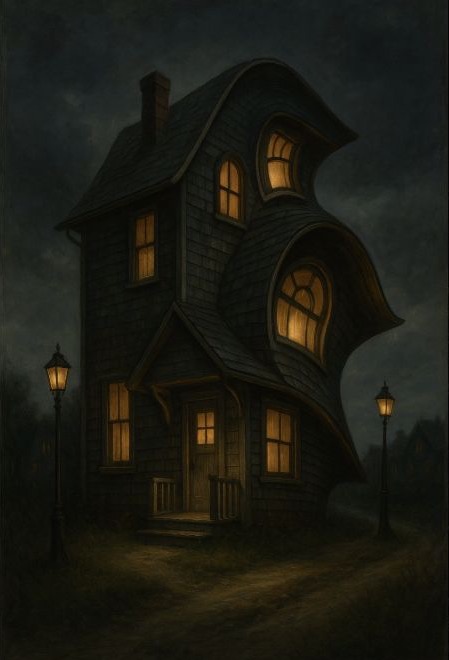
When one has catalogued the dreams of civilizations long enough, one begins to notice that geometry misbehaves around loneliness.
Corners lean closer than they should. Angles refuse ninety degrees out of sympathy. A line, if stared at too long, begins to remember its curvature.
It was late on a Wobbleday evening when the lamps dimmed in the Aisle of Forgotten Architectures.
I was completing the usual reshelving. There were Atlases of Impossible Rooms and several dissertations on hyperspherical kitchens. As I reached for the final volume, a small black notebook slipped from a shelf marked “Private Topographies.”
It landed spine first on my shoe, humming faintly in F minor.
The cover was unremarkable. It was made of cracked leather and bore no title. Inside, however, the handwriting was exquisite. It was precise to the point of obsession, with every letter aligned as though obeying an invisible blueprint.
Its unnamed author described the study of a peculiar dwelling encountered “between dreams, adjacent to wakefulness, address unknown.”
According to the manuscript, the narrator was an anonymous tenant, perhaps one of the Lost Engineers of Elsewhere. He had taken residence in what first appeared to be a small suburban home.
Upon stepping through its doorway, however, he discovered that the hallway extended far beyond Euclidean expectation.
Each step shortened him slightly. Each turn returned him to the threshold from which he had come, only older by an imperceptible minute.
The kitchen, he wrote, “was kind enough, though gravity drifted toward the stove out of old affection.”
Cups orbited the sink like minor moons. A teaspoon hung in the air, contemplating entropy. Every night, the chairs arranged themselves into hexagons. They were never quite perfect, but they were always polite.
At dusk, or what passed for dusk inside the house, the walls sighed.
“Its architecture,” the tenant confessed, “was aware of me. The walls remembered other occupants, including dreamers, cats, and perhaps gods. They shifted slightly to accommodate my insignificance.”
He named the phenomenon domestic curvature. It was the tendency of inhabited space to fold gently toward its inhabitant, as though empathy were a physical law.
By the final pages, the handwriting had deteriorated into elegant spirals.
“My reflection has learned recursion,” he wrote. “Mirrors do not return images. They borrow futures. The bed unravels into Möbius ribbons of warmth. Sleep occurs on both sides of consciousness.”
The final entry contained only one warning:
If the house asks you to stay, do not decline. You are already home.
Then there was nothing.
Only a smear of graphite shaped like a perfect dodecahedron.
Ms. Understood
Bob’s whiskers twitched.
“I knew it,” he murmured. “Plato.”
He looked at Missy. She was still asleep, although her fingers had curled as if holding an invisible thread.
He returned the bookmark to its place and closed the Red Book. Outside their compartment, the train corridor appeared to have grown longer.
Bob stared at it for several seconds. Then he lowered his hat over his eyes and decided that, for the moment, the corridor could keep its explanation to itself.

Leave a comment