
Most people in Emberpolis grew up with simple advice about relationships.
Be honest. Be kind. Do not marry anyone who refuses to apologize.
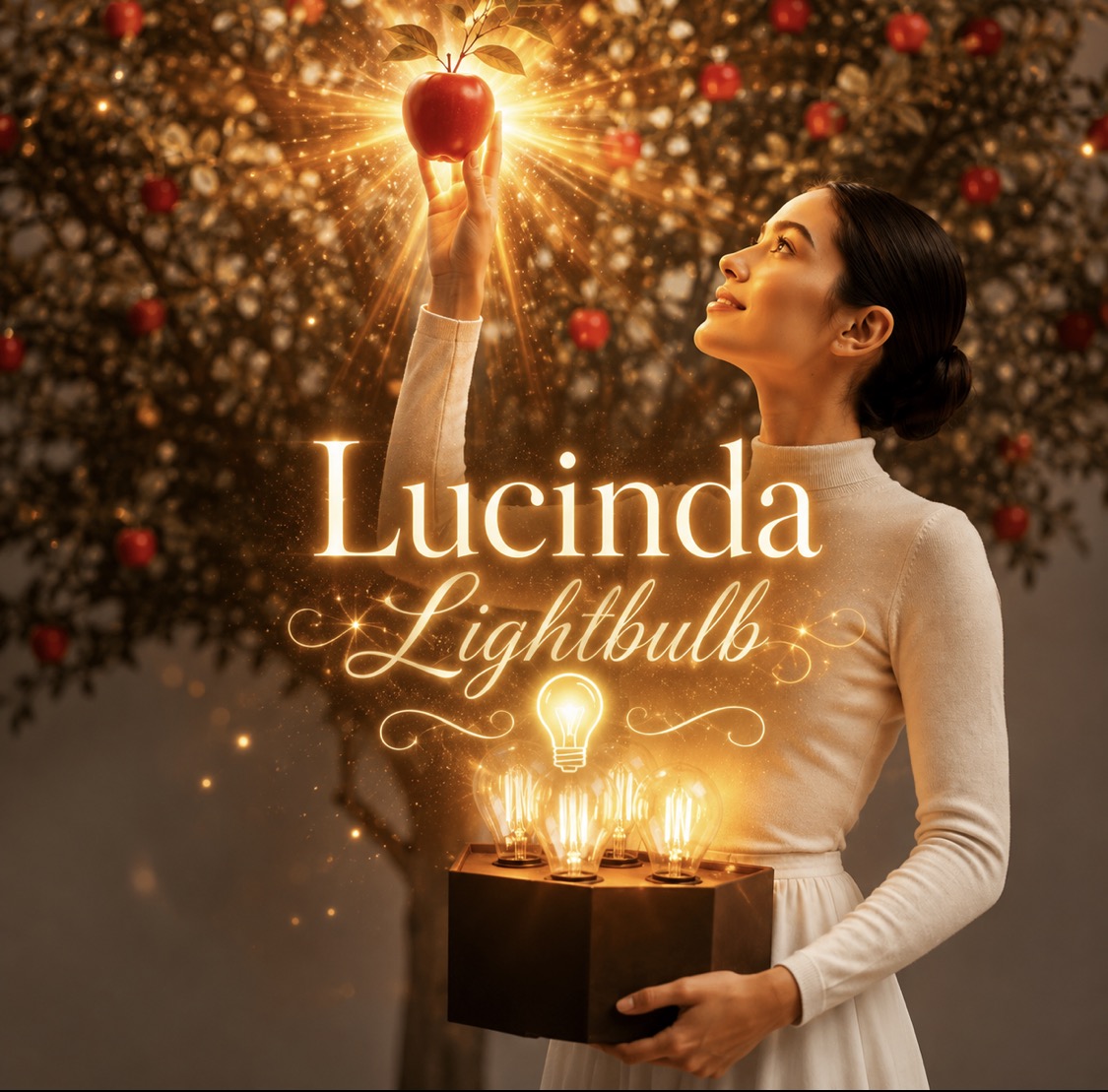
Lucinda Lightbulb did not.
She was raised by two elders who believed that love was an experiment: a matter of the right formula, the right physics, or the precise kind of heat applied at the right moment.
Her grandfather, Professor Harlan Lightbulb, was a chemist with a beard that smelled faintly of peppermint solvents.
Her grandmother, Dr. Elara Finch, was a sharp-eyed physicist whose cheekbones looked carved by a laser.
Both adored Lucinda.
Both shaped her.
Both confused her delightfully.
And so Lucinda grew up with two ways of understanding relationships: chemistry and physics. They were completely incompatible, or so she was told.
They were also completely correct.
Grandfather Harlan believed people were chemical reactions in walking form. Whenever Lucinda sat with him in his warm, cluttered greenhouse, he would mutter:
“Child, relationships are a matter of heat transfer.”
Some people were exothermic. They gave warmth easily. They glowed with generosity. Being near them raised your emotional temperature.
Others were endothermic. They absorbed heat endlessly. They seemed cold until given enough warmth to begin their reaction.
Attraction was activation energy.
“You need a spark,” he said, tapping her forehead.
Compatibility was reaction stability. Two people who fit well reached equilibrium without exploding.
Heartbreak was thermal shock: a sudden change in emotional temperature that cracked the beaker.
His most repeated proverb was:
“If someone doesn’t warm you, the reaction won’t run.”
Lucinda loved this. She loved the way he made love sound like a gentle experiment with teacups full of sun.
But her grandmother had very different ideas.
Elara walked with a measuring mind and a starlit heart. She saw the universe in force fields, resonance, frequency, and precision.
Lucinda remembered sitting beside her on the balcony at midnight while Elara explained:
People are oscillating systems.
Attraction is frequency matching.
Love is a closed-loop current.
Empathy is constructive interference.
Conflict is signal noise.
Breakups are circuit discontinuities.
And her grandmother’s favorite:
“A soulmate is simply someone whose waveform stabilizes yours.”
Elara once built Lucinda a tiny magnetic pendulum to demonstrate emotional resonance. Lucinda played with it for hours.
Physics was not warm like chemistry.
But it was pure.
Precise.
Comfortingly reliable.
Most people would have chosen one worldview and rejected the other.
Lucinda did not.
She saw that her grandparents were looking at the same truth through different wavelengths.
Thus, her own system was born:
Thermal for emotion.
Electrical for connection.
She believed love required enough heat to start the reaction and enough current to sustain it.
She combined them in her now-famous notebook entry:
“A relationship needs two things: ignition and conductivity.”
Her theory became legendary in Emberpolis. People came to Illuminated just to hear her explain it over cups of ember tea.
Whenever someone asked which of her grandparents had been correct, Lucinda smiled and said, “Both, obviously. You heat the heart. You wire the soul. It is not difficult.”

Leave a comment