
Life is a dark parody because it insists on meaning while refusing consistency. It offers patterns just long enough for us to trust them, then changes the rules without notice. It hands out roles, scripts, diagnoses, virtues, and villains, then watches what happens when we begin believing them.
Tragedy wears the costume of importance. Comedy wears the costume of accident. Life keeps exchanging the masks when no one is looking.
The cruelest part is not suffering. It is timing.
Punchlines arrive late. Explanations arrive before wisdom and after damage. Apologies arrive once the scene has already been framed.
And still, people demand coherence. They ask for arcs. They want the circle closed.
So life obliges, badly. It offers closure that closes the wrong thing, answers that stop inquiry, and labels that feel like relief until they become cages.
That is the parody. Life is not meaningless. It keeps offering meaning slightly off center, just enough to reveal who prefers comfort over accuracy, certainty over truth, and a familiar lie over a destabilizing insight.
Laughing helps. So does noticing when the laugh catches in your throat. That is usually the moment it begins telling the truth.
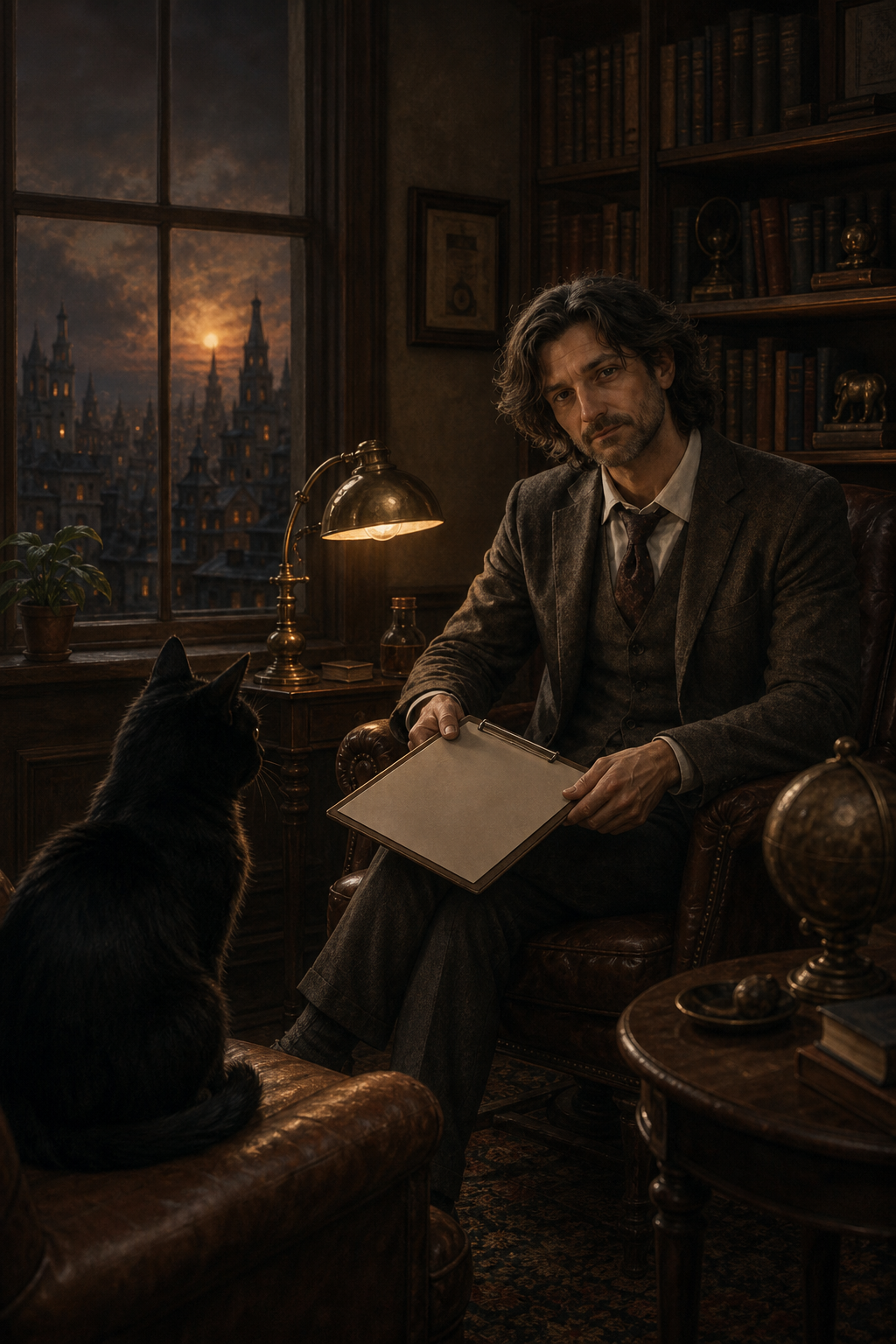
Dr. Lionel Schrink had built his practice around that uncomfortable moment.
He was the kind of therapist people underestimated immediately and regretted it slowly.
He was not dramatic. He did not lean forward, reassure, chase insight, or interrupt spirals. He allowed them to finish collapsing on their own. His presence mildly destabilized people who mistook urgency for intelligence.
Dr. Schrink specialized in what he called premature meaning: the human tendency to explain pain before it had finished forming. He treated overthinking not as a cognitive defect, but as a grief reaction to uncertainty.
When clients demanded answers, he offered timing. When they asked what something meant, he asked whether it had finished happening yet.
His sessions were known for three things:
- Long pauses that felt unproductive until several days later.
- Questions that arrived after the urge to answer had passed.
- A persistent refusal to rescue anyone from their own speed.
On the Train to Elsewhere, people consulted Dr. Schrink quietly, and often too late. They usually arrived after explaining themselves into a corner, hoping he could help them escape without requiring them to admit that the explanation was the problem.
His unofficial motto, overheard once by Bob the Black Cat, was simple:
Most people do not need insight. They need to stop interrupting themselves.
Bob remained suspicious.
When he flicked an ember-bright glance at the therapist’s clipboard, he found it empty. Suspiciously empty.
Anyone could sit without speaking. Only a few could sit without preparing a meaning in advance. Bob had not yet decided whether Dr. Schrink belonged to that smaller group.
So Bob remained still, ember eyes wide, offering no confession, contradiction, or hook.
If Dr. Schrink truly practiced presence, he would survive the absence of material.
If not, he would eventually fill the silence.
Bob was willing to wait.
He always was.

Leave a comment