
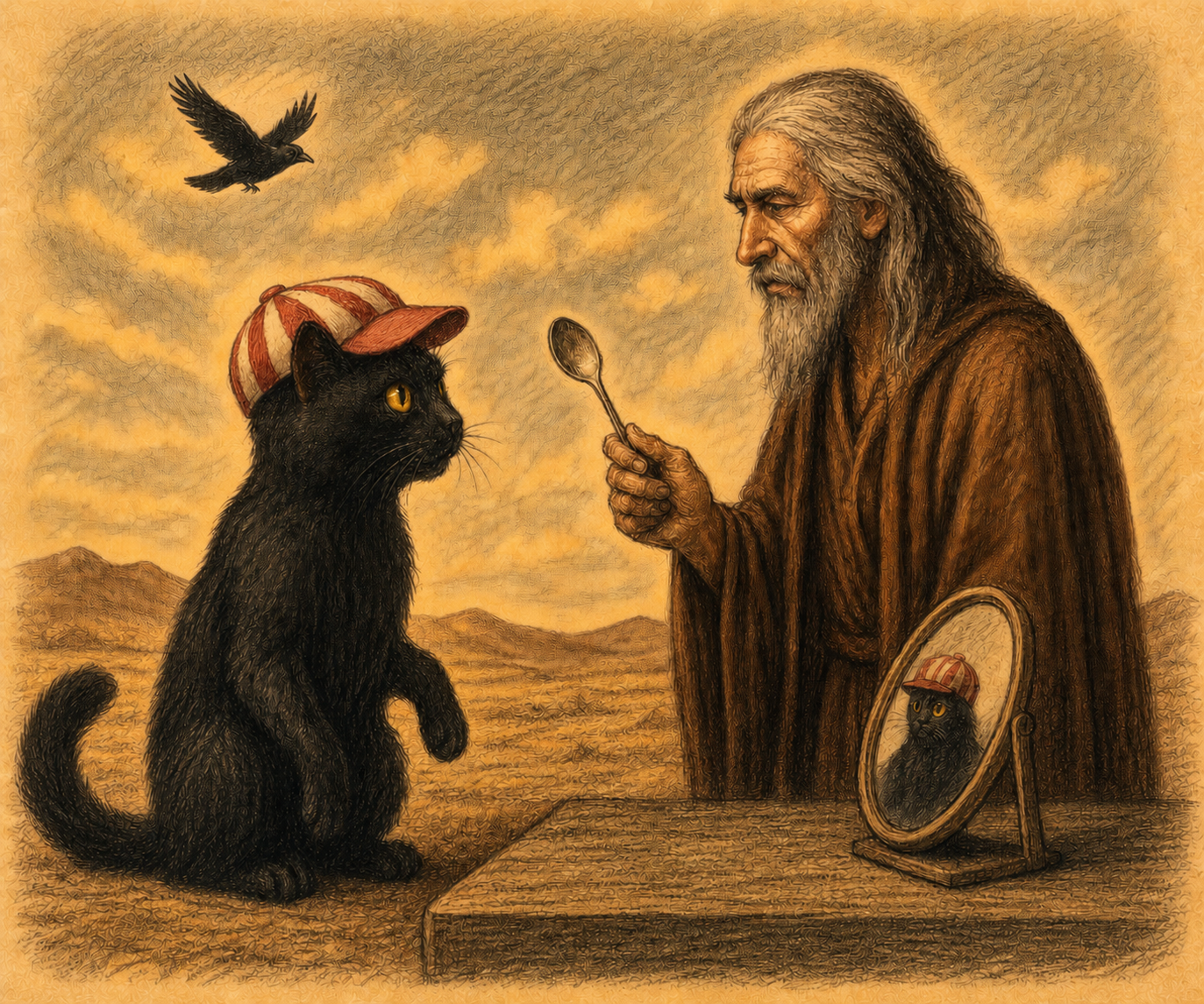
There he stood, a strange old man in a timeless manner in the middle of desert: half shaman, half mirage.
Don Juan Matus appeared as if he had just risen from the desert sand itself—not walked, not arrived, but emerged when the wind had sighed and shaped him from the memory of a desert.
He was simply there—holding a tarnished silver spoon that trembled slightly in the wind. A crow flew overhead, then vanished without sound, as if it had forgotten it was not meant to exist. At least not in this story. Don Juan’s eyes were steady, ageless, a little too calm for comfort.
Bob adjusted his red-and-white striped circus cap, tilted for optimal questioning, and took a hesitant step forward, paws sinking slightly into the warm dream-dust.
“I am Bob, the Black Cat … who are you, dear? …” He paused. He meant to say “Mister,” but something in the stranger’s cloakless presence made that feel too small or too Western.
Before Bob could finish his second thought, the man replied with a voice as dry as the desert and as precise as a falling feather.
Man: “I am Don Juan Matus.”
Bob blinked. Twice.
There was something unnerving about the way the spoon shimmered, not with light, but with implication. Bob narrowed his eyes.
“Dear Mister Don Juan … I am so very curious to learn how to bend a spoon. And since you’re already holding one … would you by chance know how to bend it?”
Don Juan didn’t answer at once. Instead, he turned the spoon toward the desert breeze, as if inviting it to speak. Then he looked at Bob with eyes so calm, eternal, and slightly amused by all feline formality, and said:
“Curiosity is the first bend, Bob! But to bend a spoon,” then he paused, “It must want to change. And to find that out, you must speak its language.”
Bob squinted with that particular feline skepticism reserved for shamans and talking utensils and said—this time in a Texan dialect:
“Howdy. I’ve never seen a talking spoon. How do I convince the spoon to change?”
Don Juan’s expression didn’t move. But the desert did.
Yet finally Don Juan spoke—although this time, dead serious:
“If you have never seen a talking spoon, how do you expect it to bend?”
Bob opened his mouth. Closed it. Opened it again.
“Magic?” he murmured with hesitancy.
The wind, just for a moment, hesitated too.
Don Juan: “The only way to bend a spoon is to gift it out how to talk to it. Solve the riddle first, and I’ll teach you the rest.”
Bob looked down. The spoon in Don Juan’s hand shimmered, not with light, but with meaning he didn’t yet understand.
Then everything spun. Not clockwise. Not counterclockwise. But spoon-wise, a motion that only dreams and galaxies tend to recognize.
Bob jolted awake. He was back in his cabin. The train had stopped.
Outside the fogged-up window, a brass sign gleamed in soft lunar light: Agnostic Spoon Station. The air smelled faintly of herbal tea and electromagnetic radiation.
A golden spoon was now pinned to his lapel, but he didn’t remember putting it there. On the floor lay the Spoon Digest, folded differently now, with a coffee ring in the exact shape of a question mark.
Bob scratched his whiskers, gazed at the window, and muttered:
“Well, guess I better learn Spoonish.”
Then he reached for his suitcase, gently placed his Wobbleday Hat into the suitcase and noticed a strange mirror.
Somewhere in the Land of Nowhere, a little girl chuckled in her dream, as if pleased with her own punchline.
Continue the journey
Enjoying The Train to Elsewhere?

Leave a comment