
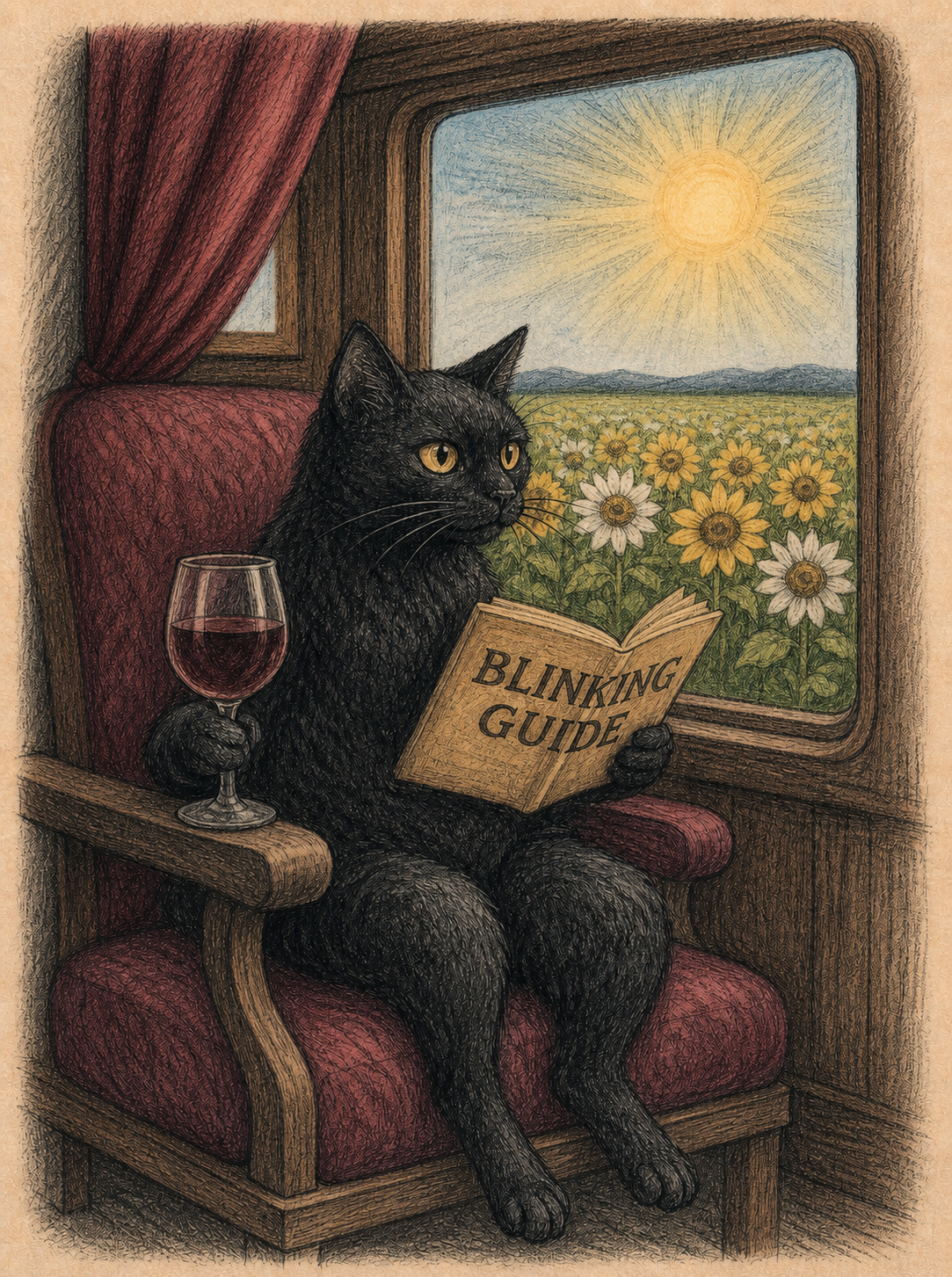
Among seasoned passengers aboard the Train to Elsewhere, communication goes beyond words. The eyes speak in ancient codes, although no one remembers who wrote the code to begin with. More often than not, the windows whisper memories, and even a single blink may hold entire metaphysical paragraphs.
Blinking once means: “I see it too.” It is a silent acknowledgment that something strange just occurred, be it a thought that manifested into fog, or the wallpaper breathing for a moment too long. However, depending on metaphysical context, it could also easily mean: “I’m not afraid.” Often initiated when the train lurches toward the unknown, or when the lamp begins to dance during the Second Waltz. But most commonly, it means: “I’m here.” It’s a quiet way of anchoring presence in an ever-shifting Elsewhere. If a long conversation is held between the passengers, one blink could mean: “Carry on.” It often replaces a nod. However, what constitutes a long conversation on the train is not established yet.
Blinking twice means: “Wait, did you see that?” It is a sign of brief confusion or awe, common after glimpsing paradoxes, time loops, or a philosophical argument. However, if it blinks twice while entirely alone, it most likely means: “Reality just glitched.” In rare occasions, as repressed dreams resurface, which quite frankly could be observed on a daily basis in new passengers, twice-blink means: “I remember something I never lived.” If a fellow passenger replies back with twice-blink, it simply means: “You’re not alone.” Passengers don’t always know they’re using this language. But the train does, and so does Bob.
Continue the journey
Enjoying The Train to Elsewhere?

Leave a comment