
Before it had a name, it had a sound. I mean the train. Not a whistle. A hum. A tone so low it moved through the bones before it touched the air. It wasn’t heard, it was remembered. Somewhere between a thought forming and a soul stirring, the train vibrated. It didn’t approach with velocity. It tuned itself. The whole engine was forged from the alchemical law of vibration: “All is motion. Nothing rests.”
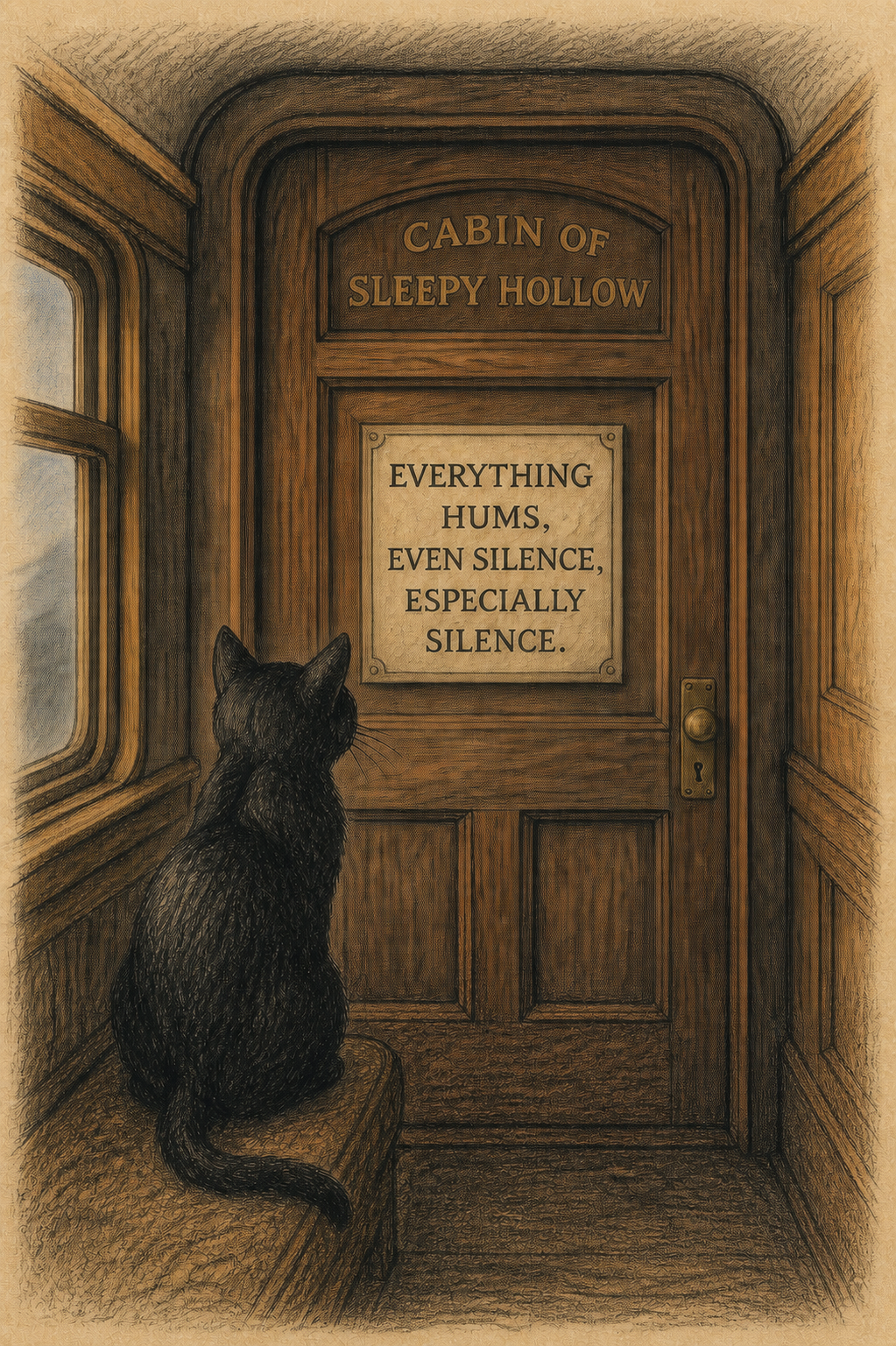
That was the first principle, engraved on the very first cabin of the train, the one closest to the Conductor’s room. The Cabin of Sleepy Hollow was marked with a number generated by a random number generator, which oddly enough, was invented long after the train came to be. The principle read: “Everything hums, even silence, especially silence.”
The sound wasn’t mechanical. It was ancestral. It was the music of Elsewhere. (Bees, in particular, were well-versed in it.) Some say the train invented itself, a soft contradiction rolling on tracks not made of iron, but of maybe. A metaphysical maybe, not the kind of maybe labeled as indecision by the scientists of mind in Reality as humans know it. It doesn’t run on time. It runs on timing.
The timing though, it doesn’t even have to be perfect. It may even arrive when you’re not quite ready, but almost brave. And you don’t board it by foot. You board it by pause—one might say, by taking a little break from reality into the inner sanctum. Its engine doesn’t roar. It exhales, rather, right after the inhale, of course.
The train is not flashy. It wears no uniform of mass-produced wonder, but rather a conservative one. No unicorns or bright colors. More like a sweet childhood dream before adults shower it with all kinds of made-up stories and toys.
At first, a few claimed it was an alien, some kind of interstellar ferry from the Ministry of Intergalactic Explorations. Or maybe even Martians. But after the philosophers began boarding, they quickly dismissed the idea. Not because it wasn’t strange, but because it was too precise. Too entangled with things they had tried for decades to name. They took notes, sketched doorways and memory-upholstered seats, debated whether the train moved through dream or dream moved through the train. One of them tried to publish a paper on it. The train quietly ate the paper and returned his pen, uncapped. The message was clear: Don’t be cute.
Bob, for one, didn’t expect to board it that day. He had only just blinked into being, still adjusting his whiskers and checking his tail for alignment, when the train unfolded before him like a polite riddle. “Hop in, if you’re inclined,” the door seemed to say. “No pressure. Just mystery.” And so, he did. Inside, it was quiet. Not silent. Just … considerate. He was greeted by the Conductor—a small conductor with a clipboard, vest buttoned to perfection, and the kind of eyes that knew things you hadn’t told yourself yet.
“Literary Territory’s in the back,” the conductor said, then added: “Tea’s steeped. Lemon’s fresh. Help yourself.” It was the lemon that did it. The scent curled around him like a ribbon, and a memory: sharp and yellow, floated up from the cellar of his mind. He was just a little kitten. Too happy. Too open. The kind of child who waved at shadows and giggled at clouds. And his mother, wise in the way that mothers often are, handed him a slice of lemon before they left the house.
“Here,” she said, pressing it gently into his paw, “put a little grin on your face, just a small one. You can’t walk out into the world happy like that. People will misunderstand. They say they love joy, but trust me, people hate too-happy people. It’ll save you some heartache.”
So he learned, one sour slice at a time, to tuck his brightness just beneath the surface—smile with corners, not with teeth. And now: years, dimensions, and paradoxes later, he stepped into the train, took his seat, lifted the teacup and smiled. Just a little more than usual.
Continue the journey
Enjoying The Train to Elsewhere?

Leave a comment